


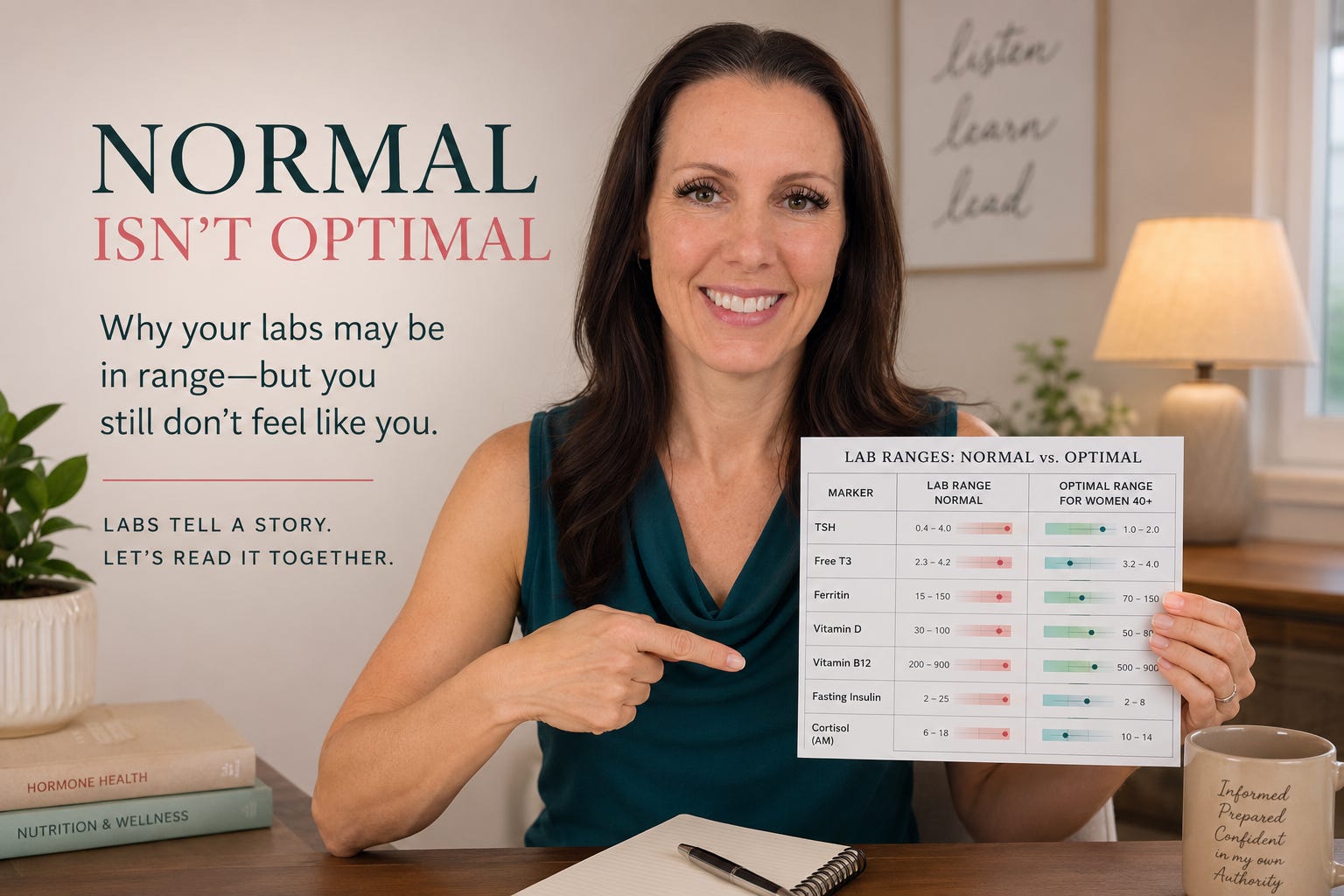
Normal is not a health target.
It’s a math problem. Somebody took a big pile of lab results from whoever walked through the door, chopped off the top and bottom slice, and called the middle chunk normal.
That’s it. That’s the whole thing.
So when your results come back and somebody tells you everything is normal, they are not telling you that your body is working well. They are telling you that your numbers look like everybody else’s numbers.
And everybody else is exhausted too.
You already know how this goes
You finally made the appointment. Waited three weeks for it. Sat there in the paper gown rehearsing your list so you wouldn’t forget anything, because you get about eleven minutes and you know it.
You said the words out loud. I’m exhausted. I’m gaining weight even though I’ve tried everything. There is so much hair coming out that I have to stop and clean the drain twice before I can finish a shower. Sleep? What sleep. I finally go under and it feels like about four minutes before I’m wide awake at 3 a.m. again. And more than anything, I just don’t feel like myself.
They ran some labs. A few days later your phone buzzed with a portal notification, and you opened it standing in your kitchen.
Everything looks normal!
Exclamation point and all. Like it was good news.
And you just stood there staring at the screen thinking, then what is wrong with me?
Here’s what I need you to hear before we go one more sentence. Nothing is wrong with you. Something is wrong with the word normal.
Grading on a curve
Everybody assumes a reference range is a health target. Like somebody in a lab coat studied thriving women and decided this is the zone where a body actually works.
That is not what happened.
Think about who is in that pool of results. Not marathon runners sleeping nine hours a night. It’s the people who went to the doctor. Tired people. Stressed people. People on four medications. Women in the exact shape you’re in right now.
Normal doesn’t mean healthy. Normal means common.
It’s grading on a curve in a class where most of the class is struggling. If everybody bombs the test, a 62 becomes a B. You didn’t get better. The standard got lower.
And here’s the part that makes me want to flip a table. Those ranges shift over time as the population gets sicker. The bar doesn’t hold still. It drifts down to meet us.
Fine is not a finish line. Fine is a bell curve.
Not empty is not full
Your gas gauge has a range. All the way full down to that little red line, and technically anywhere above the E is within range. You’ve got gas. The light isn’t on.
But you and I both know the difference between a full tank and driving on fumes, doing math in your head about whether you can make it to work and back.
Both are inside the range. Only one of them lets you stop thinking about it.
That’s your labs. That’s your energy. That’s your whole life right now.
You’re not asking to be inside the range. You’re already there. You’re asking to stop running on fumes and calling it a life.
What normal is actually hiding
Let me show you the patterns I see over and over.
The thyroid one. Your TSH comes back at 4.1. The range on the paper says something like 0.45 to 4.5, so you’re inside it, so nobody says a word. Meanwhile you’re freezing when everyone else is comfortable, your hair is thinning at the temples, your brain turns to soup by 2 p.m., and you haven’t had a normal bowel movement since the Obama administration.
Now here’s the thing almost nobody tells you. TSH isn’t even a thyroid hormone. It comes from your pituitary, a gland in your brain, and its whole job is to send a message down to the thyroid asking for more.
So when we measure TSH, we’re not measuring your thyroid. We’re measuring the request. It’s like judging how well an employee is performing by reading their manager’s emails. You can see what was asked for. You still have no idea what actually got done.
The hormones that tell you what actually got done are Free T4 and Free T3, and antibodies would tell you whether your own immune system is part of the story. Most of the time not one of them gets run.
So you get one number, out of context, sitting at the edge of a range built on tired people, from a gland that isn’t even the one in question. And on the strength of that, you get told you’re fine.
The blood sugar one. Fasting glucose 97. Normal, technically, because the cutoff is 100. Meanwhile you crash so hard at 3 p.m. that you’d sell your car for a nap, you’re hungry an hour after you eat, and the weight keeps coming even though you swear you’re doing everything you did at 35.
And nobody scrolls back to see that you were 84 five years ago, then 88, then 92, then 97. That’s not a number. That’s a direction.
Nobody watches the trend because nobody looks at anything except today’s box, and today’s box says normal. By the time it finally crosses the line into a diagnosis, you have been sliding for a decade while everyone told you that you were fine. The test that would have caught it years earlier, fasting insulin, usually never gets run at all.
The iron one. Ferritin at 22. The range starts at 15, so, normal. Meanwhile you’re pulling handfuls of hair out of the drain, you’re wiped by mid-morning, and your legs won’t hold still at night. Iron stores at 22 are technically not deficient. They’re also nowhere near where a woman’s hair, energy, and thyroid actually want them to be.
The vitamin D one. You’re at 31. The lab flags anything under 30, so you cleared it by a single point and got a thumbs up. It’s February. You live in Oregon. You have not seen direct sunlight since October. Meanwhile your mood has flattened out, you’re dragging by 10 a.m., everything aches a little, and the weight will not move no matter what you do. Low vitamin D has its fingerprints on all three of those.
Every one of those results got called normal. Every one of those women went home and typed “why am I so tired if my labs are normal” into her phone at 2 a.m., because she knew she wasn’t making it up and she had nothing to hold on to.
I know you’ve been on that search. I know what those open tabs look like at 2 a.m.
The part that does the real damage
When you feel awful and the paper says you’re fine, one of two things has to be true. Either the test missed something, or you’re making it up.
Guess which one most women pick.
Nobody has to say the words it’s all in your head. They just hand you a normal result and leave you no other explanation. You do the rest yourself.
So you start hedging. You say I know it’s probably nothing, but. You apologize before you describe your own symptoms. You start wondering if you’re dramatic, or lazy, or just getting older, or not trying hard enough.
That’s the injury I care about most. The moment a woman learns to dismiss herself, because she was taught that her lived experience doesn’t count as evidence.
It counts. You are the only person on this earth who has been inside your body every single day of your life. Every symptom you noticed, every pattern you clocked, every time you thought this started around the time that changed, you were gathering something.
You called it complaining. I want you to hear it a different way.
You were collecting evidence.
Nobody on this planet has more data on you than you do. Not a provider, not a lab, not a chart. Eleven minutes in an exam room does not compete with the decades you have spent living in there. That isn’t a nice thing I’m saying to make you feel better. It’s just true.
You were always the expert of your own body. Nobody ever told you that, so you handed the job to someone else and assumed it was covered.
Two questions that change the conversation
I’m not telling you to storm in swinging. That doesn’t work, and most providers are drowning inside an eleven-minute system nobody designed for this.
I’m telling you to ask a better question. Better questions get better conversations.
Instead of accepting “everything looks normal,” try this. I can see it’s in range. Where in the range is it, and has it been moving?
That one question drags the trend into the room. In range and drifting for six years is a completely different story than in range and holding steady.
Then this one. What would we need to look at to explain how I actually feel?
Not what’s normal. What would explain this. Those are two different investigations, and only one of them is looking for you.
What a lab result actually is
I want to be straight with you, because I’m not here to sell you the idea that a blood draw is going to hand you your life back.
A lab result is a snapshot. One moment, one day, one set of conditions. Take it at a different point in your cycle, after a rough night, while you’re fighting something off, or before your morning coffee instead of after, and the number moves. Labs use different ranges from each other. Some tests measure the wrong thing entirely, like asking the manager instead of checking the work.
Testing isn’t the answer. Testing is information, and information is the thing you have been denied.
Because here’s the gap nobody names. A lab can measure what’s in a tube. It cannot measure the way your body feels from the inside. It can’t see the 3 a.m. wake-ups, the fog, the dread you feel at the bottom of the stairs. Only you have that. You are the primary witness, and your account belongs right there in the evidence next to the numbers.
Numbers plus your story is a picture. Either one on its own is a guess.
A normal result was never supposed to be a door closing. A result is supposed to open the conversation, not end it.
The line I want you to walk out with
Normal is not optimal. Normal is just the crowd you got averaged into.
Optimal is getting through a Tuesday without a nap and a snack to survive the afternoon.
You are allowed to want more than not being sick. You’re allowed to want energy, and a brain that works, and sleep that actually puts something back. That is not a high-maintenance ask. That’s the floor.
You were never broken. You got measured against the wrong standard, and then handed the blame for the gap.
I have seen this from both sides. I’ve stood in the room as the nurse while a woman was told her symptoms were nothing. And I’ve sat on the table as the patient and heard the same thing about mine.
That’s why I wrote this. I want you to know you are not alone, and you deserve better.
Welcome. I’m glad you’re here.
I’m Tina, a registered nurse who got tired of watching women get told they’re fine when they clearly aren’t. Every week I write about what your symptoms are trying to tell you, what’s worth testing instead of guessing at, and how to walk into your next appointment prepared instead of apologizing.
Because symptoms are information, not character flaws. Normal was never supposed to be the end of the conversation. And you were always the expert of your own body, whether anyone told you that or not.
Free to subscribe, and I’d love to have you.
Disclaimer:
The information shared in this publication is for educational and informational purposes only. It is not medical advice and is not intended to replace guidance from your physician or another qualified healthcare professional.
Do not use this information to diagnose, treat, cure, or prevent any health condition, or to make decisions about medications, supplements, or other forms of treatment. Always speak with your healthcare provider before starting, stopping, or changing any medication, supplement, nutrition plan, or treatment.
If you have a medical concern, or believe you may have a medical condition, contact a qualified healthcare professional promptly. Do not disregard professional medical advice or delay seeking care because of something you read, hear, or view in this publication.
Your use of this Substack, podcast, or any related products or services does not create a nurse-patient, client or coaching relationship with Tina Hergert.
Statements regarding dietary supplements have not been evaluated by the U.S. Food and Drug Administration. Supplements are not intended to diagnose, treat, cure, or prevent disease.