

Picture her.
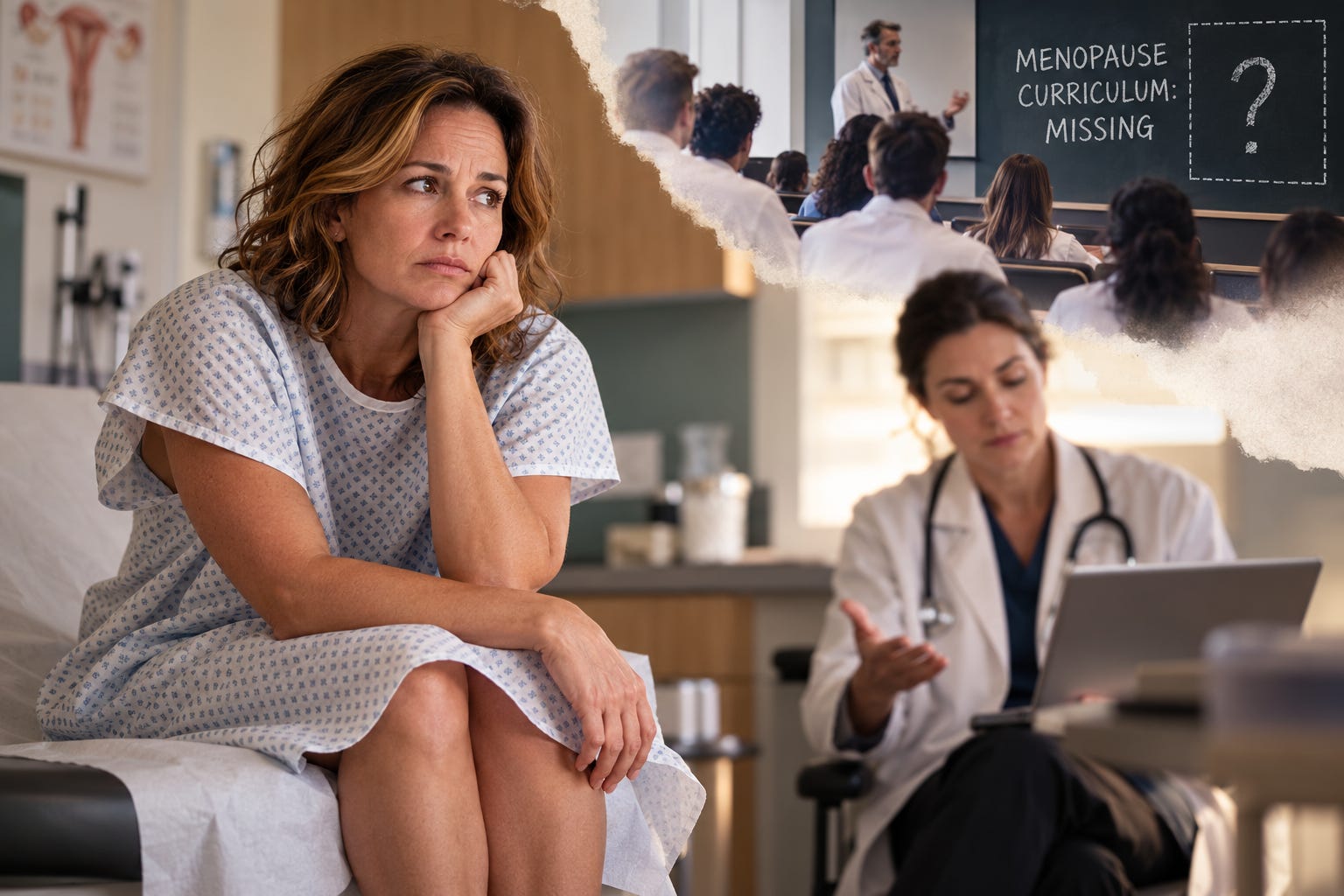
She’s 47, sitting on that crinkly paper in a gown that doesn’t close in the back. She hasn’t slept through the night in months. She’s sweating through her sheets, forgetting words mid-sentence, and snapping at people she loves for reasons she can’t explain. She’s been saving this list in her phone for weeks.
She gets through about half of it before the doctor glances at the screen and says, “Your labs look normal. It’s probably just stress. Have you tried getting more exercise?”
Fifteen minutes later she’s back in her car, staring at the steering wheel, wondering if she’s losing her mind.
She’s not. And her doctor probably isn’t a bad doctor, either.
I’ve been on both sides of the chart. I’ve been the nurse standing in the room while a woman got the shrug, and I’ve been the woman getting it. For a long time I assumed the people brushing us off were overworked, overloaded or just didn’t care.
Then I looked at how they were trained. Or more honestly, how they weren’t.
Your doctor didn’t skip class. For a lot of them, there wasn’t one.
The class that never made the schedule
In 2019, researchers at Mayo Clinic surveyed residents in family medicine, internal medicine and OB-GYN. These are the doctors in training who will become the primary care providers and gynecologists most women see.
More than 1 in 5 said they’d had zero menopause lectures during residency. Not a few. Zero.
Only 6.8% said they felt adequately prepared to manage women going through menopause. That’s 12 people out of 177.
And about a third said they wouldn’t offer hormone therapy to a healthy woman with symptoms who had just gone through menopause and had no reason not to take it.
Now you might be thinking, okay, but surely the OB-GYNs get it. They’re the women’s health specialists.
In 2022, researchers asked OB-GYN residency program directors across the country what their programs actually teach. Only 31.3% said they had a menopause curriculum at all. And in the programs that did, every one of them reported five lectures a year or less. Most had two or fewer.
Two lectures. For something every woman who lives long enough will go through, and many will spend a third of their life on the other side of.
The program directors weren’t happy about it either. They rated their own menopause training 3.75 out of 10. Nearly all of them agreed residents should have a standardized menopause curriculum.
So it’s not that nobody cares. It’s that nobody built it into the schedule. Dr. Stephanie Faubion, medical director of The Menopause Society, put it bluntly: “There is no room in the medical school curriculum for menopause.”
No room. For half the population.
What the missing class sounds like in the exam room
When someone wasn’t taught something, they don’t usually say “I don’t know.” They reach for what they do know.
That’s how you get “your labs are normal,” when nobody explained which labs were run or what normal even means for you. It’s how you get “it’s just your age,” “it’s probably stress,” “have you tried losing weight?” and the classic “just ride it out.” Or the antidepressant prescription that shows up before anyone has asked a single question about your cycle.
That’s not always a bad doctor. A lot of the time it’s a knowledge gap with a confident face. Add a 15-minute appointment and a waiting room full of people, and the shrug becomes the default.
Women feel it. In a 2022 KFF survey of more than 5,000 women, 29% said a doctor had dismissed their concerns in the past two years. And in a 2025 Mayo Clinic study of nearly 5,000 women ages 45 to 60, about 84% had never sought care for their menopause symptoms at all. About 1 in 4 said their doctor hadn’t taken a full symptom history or clearly explained their treatment options. And 22% didn’t even know effective treatments existed.
Read that again. These women aren’t skipping care because they feel fine. They’re busy, they’re embarrassed, they’re used to handling it themselves, and plenty of them have no idea there’s anything to ask for.
So let me be really clear about two things.
First, your symptoms are real. The night sweats, the rage, the brain fog, the joint pain, the 3 a.m. wake-ups. A provider not being trained to recognize them doesn’t make them any less real. It just means you got someone who didn’t have the map.
Second, this is not on you. You didn’t ask the wrong way. You weren’t too emotional, too vague or too much. You walked into a system that never taught the person across from you what to look for.
And here’s the good news. A lot of providers know it. Mayo Clinic’s women’s health training program for doctors, run with The Menopause Society, hit record physician attendance in 2023 as doctors went looking for what residency never gave them. The ones who care are catching up.
You just can’t count on getting one of them by accident.
So what do you do with that?
You stop waiting for the system to fix itself before you get answers. You walk in like the woman who knows the class was never taught.
Bring your own notes. Track your symptoms for a few weeks before your appointment. What, when, how bad, and what you’ve already tried. A provider can brush off “I just don’t feel like myself.” It’s a lot harder to brush off six weeks of night sweats written down with dates.
Ask the question nobody asks. It’s okay to say, “How much of your practice is menopause care?” or “Are you comfortable talking through hormone and non-hormone options with me?” That’s not rude. That’s how you find out if you’re in the right room.
Know what trained looks like. The Menopause Society offers a credential for providers who pass its menopause exam, called a Menopause Society Certified Practitioner, or MSCP. They have a free search tool on their website to find one near you. It doesn’t guarantee a perfect fit, but it tells you the person across from you went and got the class.
Ask for the referral. If your provider says this isn’t their area, that’s honest, and honest is good. Ask who they’d send their own sister to.
Help the next woman. I’m building a list of menopause-informed providers so women stop having to find them by trial and error. If you’ve found one who actually listened, hit reply or tell me in the comments. I want to know who they are.
Here’s the part that gets me fired up. Nobody taught your doctor this. So we’re going to learn it ourselves.
On Tuesday, November 10th, at 5:00 PM Pacific / 8:00 PM Eastern, I’m teaching a live workshop called Hormones, Minus the Hype. This is the class that never made the schedule. We’ll look at what the research actually says, walk through the full menu of options, hormone and non-hormone, and talk about how to judge the health information that lands in your feed. You’ll leave with Walk In Ready, a printable guide with the exact questions to bring to your provider, so you can walk in prepared and walk out heard. Can’t make it live? The replay will be available.
Save your seat for Hormones, Minus the Hype
Not ready for that yet? Start with the notes. Write down what your body has been telling you this month, and take it with you to your next appointment.
And if someone forwarded this to you, subscribe for free so the next one lands in your inbox. Every woman who walks in prepared changes what the next woman expects.
This article is education to help you advocate for yourself. It isn’t medical advice and doesn’t replace a conversation with your provider.
Sources
2019 resident survey: 177 respondents in family medicine, internal medicine and OB-GYN at 20 US programs; 20.3% had no menopause lectures; 6.8% (12 of 177) felt adequately prepared
Kling et al., Mayo Clinic Proceedings 2019
About a third of those residents would not offer hormone therapy to a healthy, symptomatic, newly menopausal woman; Dr. Stephanie Faubion quote
2022 survey of 99 OB-GYN residency programs: 31.3% had a menopause curriculum; all with one had five lectures a year or less, 71% two or fewer; directors rated training 3.75 of 10; 92.9% want a standardized curriculum
Allen et al., Menopause 2023, via Healio
29% of women ages 18 to 64 said a doctor dismissed their concerns in the past two years
KFF 2022 Women’s Health Survey
Nearly 5,000 women ages 45 to 60: about 84% never sought care for menopause symptoms; about 1 in 4 said their doctor hadn’t taken a full history or explained options; 22% unaware of effective treatments
Kapoor et al., Mayo Clinic Proceedings 2025, via HealthDay
Record physician attendance at Mayo’s “Transforming Women’s Health” program, run with The Menopause Society
The Hospitalist, September 2023
MSCP credential and the free practitioner search tool