

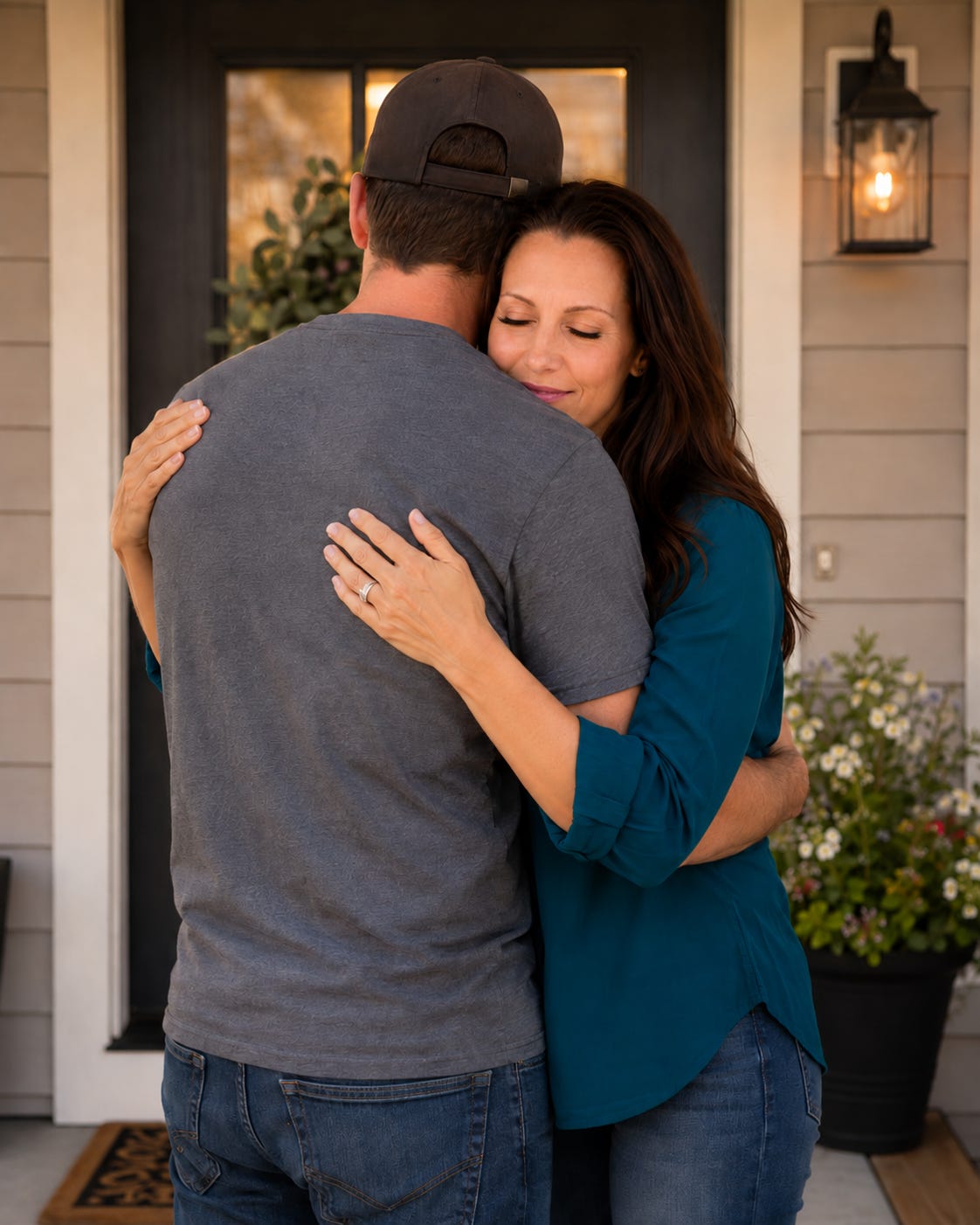
My son moved out last week.
He bought his first home, and he’s moving in with his girlfriend, and honestly, it’s one of the proudest moments I’ve had as a mom. Watching him become the man he’s become, capable, kind, responsible, ready to build a life of his own, that’s the whole point of raising a child. We’re supposed to raise them to leave us. We’re supposed to want this.
I helped him pack. I helped him move. He’s only a couple of miles away, and I still see him almost every day.
And it’s still not the same.
That part caught me off guard.
My daughter moved out almost nine years ago, and even though I missed her terribly, it didn’t hit me quite like this. I still had one child at home then. There was still someone coming and going, someone whose presence quietly shaped the rhythm of the house. My son hasn’t needed me to take care of him in the traditional sense for a long time, but there was still something about knowing he lived here. There was still this unspoken role woven into my day.
Now the house feels different.
Not bad. Not empty in some tragic way. Just different enough that I’ve found myself sitting with a question I didn’t expect to be asking at this stage of my life.
Who am I now?
I think a lot of women arrive at this question without realizing it’s coming.
Sometimes it happens when the kids leave. Sometimes it happens after a divorce, when a woman suddenly realizes she’s spent so many years being part of a “we” that she isn’t quite sure who the “me” is anymore. Sometimes it happens after retirement, when the job title disappears and so does a huge piece of the identity attached to it. Sometimes it happens when a parent dies and, no matter how old you are, you suddenly feel the strange shift of no longer being someone’s daughter in the same way. Sometimes it happens after losing a spouse, changing careers, becoming a caregiver, or finally reaching a point where the life you worked so hard to build no longer fits the person you’ve become.
In my years as a nurse, including time I spent working in mental health, I saw versions of this again and again. Women would come in saying they felt anxious, depressed, restless, disconnected, or unlike themselves. Sometimes there were clear medical reasons. Sometimes there were hormonal changes. Sometimes there was grief or trauma. But sometimes, underneath all of it, there was another question that nobody had really helped them name.
Who am I when I’m no longer needed in the same way?
That’s a hard question for a lot of women because, somewhere along the way, many of us become deeply attached to our roles.
We start out as ourselves, and then life adds layer after layer. Wife. Mother. Daughter. Employee. Caregiver. Friend. Volunteer. Problem solver. The dependable one. The one who remembers the birthdays, schedules the appointments, keeps track of what everyone needs, notices when something is off, and holds a thousand invisible details in her head at once.
We get good at those roles. Sometimes, exceptionally good.
And because we’re good at them, other people begin to know us through them. Eventually, we start knowing ourselves through them too.
The roles become so familiar that we stop noticing where the role ends and the woman begins.
Then midlife has a way of changing the job description.
Children grow up. Parents age. Careers change. Relationships shift. Bodies change. Priorities change. Some responsibilities fall away, while others arrive without invitation. The roles that once gave structure to your days start changing one by one, and suddenly you realize something you might not have admitted before.
You knew exactly who you were when everybody needed you.
You’re less sure who you are when they don’t.
“You knew exactly who you were when everybody needed you. You’re less sure who you are when they don’t.”
There’s grief in that.
And I think we need to talk more openly about the fact that you’re allowed to grieve something even when the change itself is good.
I’m thrilled for my son. I’m proud of him. I wouldn’t want him living at home forever because I needed to feel needed. I want him to have his own home, his own relationship, his own life. None of that changes the fact that I’m also grieving the end of a season.
Both things are true.
That’s where we sometimes get ourselves into trouble. We think grief needs to be justified by something terrible happening. We think if our child is healthy and happy, if the retirement was chosen, if the divorce was necessary, if the move was wanted, then we shouldn’t feel sad.
But sometimes we’re not grieving the event. We’re grieving the version of ourselves that belonged to that chapter.
Nobody sends flowers when that version of you disappears.
Nobody brings a casserole because your youngest child moved out and you suddenly don’t know what to do with the quiet.
Nobody says, “I know everyone keeps congratulating you on retirement, but I wonder if you miss being the woman people relied on every day.”
Nobody asks whether becoming free has also made you feel a little lost.
That kind of loss is quieter, and because it’s quieter, we often minimize it. We tell ourselves we should be grateful. We should be excited. We should enjoy the freedom. We should find a hobby.
Maybe…
But maybe before rushing to fill the space, we need to acknowledge that there’s a space at all.
And then let’s add another layer to all of this because, for many women, these identity changes show up right alongside perimenopause and menopause.
So while your relationships and roles are changing, your body might be changing too. Your sleep is chaotic. Your moods is all over the place. Your stress tolerance isn’t what it used to be. Anxiety hits like a ton of bricks. Your body is making changes you can’t explain. You look in the mirror and sometimes feel as though your own face has changed before you had time to catch up.
That’s a lot of change at once.
We talk about menopause as though it’s mainly about hot flashes and periods ending, but for many women, the transition is happening on several levels at the same time. Your body is changing. Your family structure is changing. Your work might be changing. Your parents are aging. Your children need you differently. Your relationships are being tested or redefined. You’re beginning to question things you used to accept without much thought.
And underneath all of that, your identity is shifting too.
No wonder so many women reach midlife and say, “I don’t feel like myself.”
Sometimes the next question is, “Which self?”
Because the woman you were at thirty isn’t necessarily the woman you are now. She served you well. She built things. She raised people. She survived hard seasons. She made decisions with the information and capacity she had at the time.
But you don’t owe her permanent residency.
Maybe part of midlife is realizing you’re allowed to become someone else without betraying who you were before.
“Maybe part of midlife is realizing you’re allowed to become someone else without betraying who you were before.”
I think that’s where this season starts to become interesting.
Viktor Frankl wrote extensively about our human need for meaning, and I come back to that often because I think meaning becomes especially important when an old role falls away. If so much of your purpose came from being needed, what happens when the need changes?
Does your purpose disappear?
I don’t think it does.
I think the role changes, but the deeper thread often stays.
Maybe motherhood taught you how deeply you care for people. Maybe your career showed you how much you value teaching, solving problems, leading, creating, serving, or advocating. Maybe caring for a parent taught you something about tenderness. Maybe divorce showed you how much of yourself you had abandoned in order to keep the peace.
The role might end, but the wisdom doesn’t.
The question becomes where you want to carry it next.
That’s one of the reasons I’ve become so interested in the idea that the second half of life isn’t meant to be a smaller version of the first.
Julie Ciardi writes about this in her book 50 Not Finished, and I love that title because it says something women need to hear more often. Fifty is not the beginning of the end. It’s not a time to sail off into the sunset. For many women, it’s the first time they have enough life behind them to see their own patterns clearly and enough life ahead of them to make different choices.
There’s something freeing about that.
You’ve lived enough to know what drains you. You’ve lived enough to know what you’ve tolerated for too long. You’ve lived enough to know the difference between what looks good from the outside and what feels right on the inside.
You also start realizing how much of your life was built around “should.”
What you should want.
How you should look.
How hard you should work.
How much you should give.
How agreeable you should be.
How grateful you should feel.
What kind of woman you should become.
At some point, “should” gets exhausting.
And maybe that’s when a different question becomes available.
What do I want now?
Not what makes sense on paper. Not what keeps everybody else comfortable. Not what proves you’re still useful. What do you want your life to feel like?
I’ve been thinking about that a lot lately.
For me, part of this season has been learning to listen to myself differently. I’ve spent much of my life pushing through things because I knew how. If something needed to be done, I did it. If a decision seemed logical, I found a way to make it work. I relied on willpower and responsibility and persistence, and those qualities served me well.
But they also made it easy to override myself.
I’m learning to pay more attention now to what feels right before I force myself into what looks right.
I pay attention to what gives me energy and what takes it away. I notice what creates a full-bodied yes and what makes something in me pull back. I’ve spent a lot of time learning about my own wiring, through the New Human Design, and the shifts in my drive, my stamina and my purpose through this work have been nothing short of amazing.
You need to know how you work.
You need to know how you make decisions when you aren’t performing for anyone else.
You need to know what your body has been trying to say while your mind was busy making plans.
For much of our lives, women are taught to override. Push through. Keep going. Do what needs to be done. Don’t disappoint anyone. Be easy to live with. Be productive. Be useful.
Midlife has made me less interested in being useful at the expense of being fully alive.
“Midlife has made me less interested in being useful at the expense of being fully alive.”
I don’t think we talk about that enough either.
There’s a line quality in Human Design that reveals about some people moving through life in distinct stages, with an earlier phase of trial and error, a middle period of stepping back and observing, and a later phase where lived experience becomes something others learn from. That idea resonated with me.
There’s comfort in believing the quieter years aren’t empty. They’re integrating something.
You’re gathering the pieces. You’re seeing patterns you couldn’t see while you were in the middle of living them.
And somewhere along the way, you start realizing that wisdom doesn’t come from having done everything right. It comes from having lived enough to know what happened when you didn’t.
That’s the kind of wisdom I’m interested in now.
Not polished wisdom. Lived wisdom.
The kind you earn by making mistakes, changing your mind, staying too long, leaving too soon, loving deeply, losing things, rebuilding, starting over, and becoming more honest with yourself every time.
Maybe that’s why this season feels both unsettling and hopeful to me.
There’s loss here. But there’s also room.
And room can feel uncomfortable when you’ve spent decades filling every available inch of your life with responsibility. The instinct is to fill it quickly.
A new project.
A new goal.
A new job.
A new identity.
Anything to avoid sitting in the question.
But maybe we don’t need to rush the answer.
Maybe “I don’t know who I am now” isn’t a crisis. Maybe it’s an opportunity.
You don’t need to see the whole picture today. You don’t need a five-year plan or a brand-new purpose by next Tuesday. You simply need enough quiet to hear yourself again.
What do you miss?
What are you relieved to be done with?
What part of you has had almost no attention for the last twenty years?
What do you still want to experience?
What do you no longer want to carry?
What feels meaningful now, even if nobody claps for it?
Those are different questions than we tend to ask when we’re younger.
And I think they’re better ones.
This is also one of the reasons I built Whole Health Simplified the way I did. I don’t believe health exists in neat little compartments. Your physical health affects your emotional health. Your emotional health affects your relationships. Your relationships affect your stress response. Your sense of purpose affects how you move through the world. Everything is connected. We are whole, complete women, not pieces and parts.
You can improve a lab value and still feel lost.
You can lose weight and still have no idea who you are underneath the version of yourself who spent years trying to become smaller.
You can optimize your sleep and nutrition and still wake up feeling like something important is missing.
That doesn’t mean the physical pieces don’t matter. They matter tremendously. They’re simply not the whole woman.
Health, at least the way I see it, needs to make room for all of you.
Your body.
Your mind.
Your emotional life.
Your sense of meaning.
Your relationships.
Your identity.
Your own inner authority.
That’s a drivng force behind the Vital Woman Journey, and it’s also why conversations like this belong here. I don’t want this publication to become another place where women are handed another top ten list of proteins, or the next quick health fix.
I see it being a place where we also talk about what it means to know yourself, trust yourself, and build a life that still feels like yours. Because when you mental, emotional and spiritual self are operating at a higher frequency, your physical health improves too.
I also want to say something important because sometimes what starts as a difficult transition becomes something much heavier. If you’re feeling persistently hopeless, disconnected, unable to function, or like you don’t want to be here, please tell someone. Reach out to a trusted friend, your healthcare professional, or a mental health professional. And if someone in your life seems to be disappearing into herself, reach toward her too.
You don’t need the perfect words. Ask her to coffee. Send the text. Sit with her. Listen.
Sometimes we underestimate how much it matters to feel noticed.
As for me, I’m still figuring out who I am in this quieter house.
I’m still Mom, of course. That doesn’t disappear because my children have their own homes and lives. But motherhood looks different now.
And maybe building this business isn’t to replace the old version of it.
Maybe it is to let this version become what it’s supposed to become, while also getting curious about the woman who has been living underneath all these roles for the last fifty-something years.
I have a feeling she still has quite a lot she wants to do.
And I have a feeling yours does too.
So I’d love to know where you are in this. What role have you had the hardest time letting go of? And if you stopped defining yourself by who needs you, what might be left?
Maybe that’s where we start.
This is such a great piece Tina! I may not be at this stage of life yt, but this really gave me a sneak peek into what I might encounter in the future…ad honestly, even though I’m not in this stage yet, the question you shared really speaks to where I am in my life right now “what feels meaningful now, even if nobody claps for it?”
Definitely need this right now. Thank you! 🤍