
Maybe your jeans fit when you get dressed in the morning, but by dinner you feel like somebody secretly swapped them for a smaller pair.
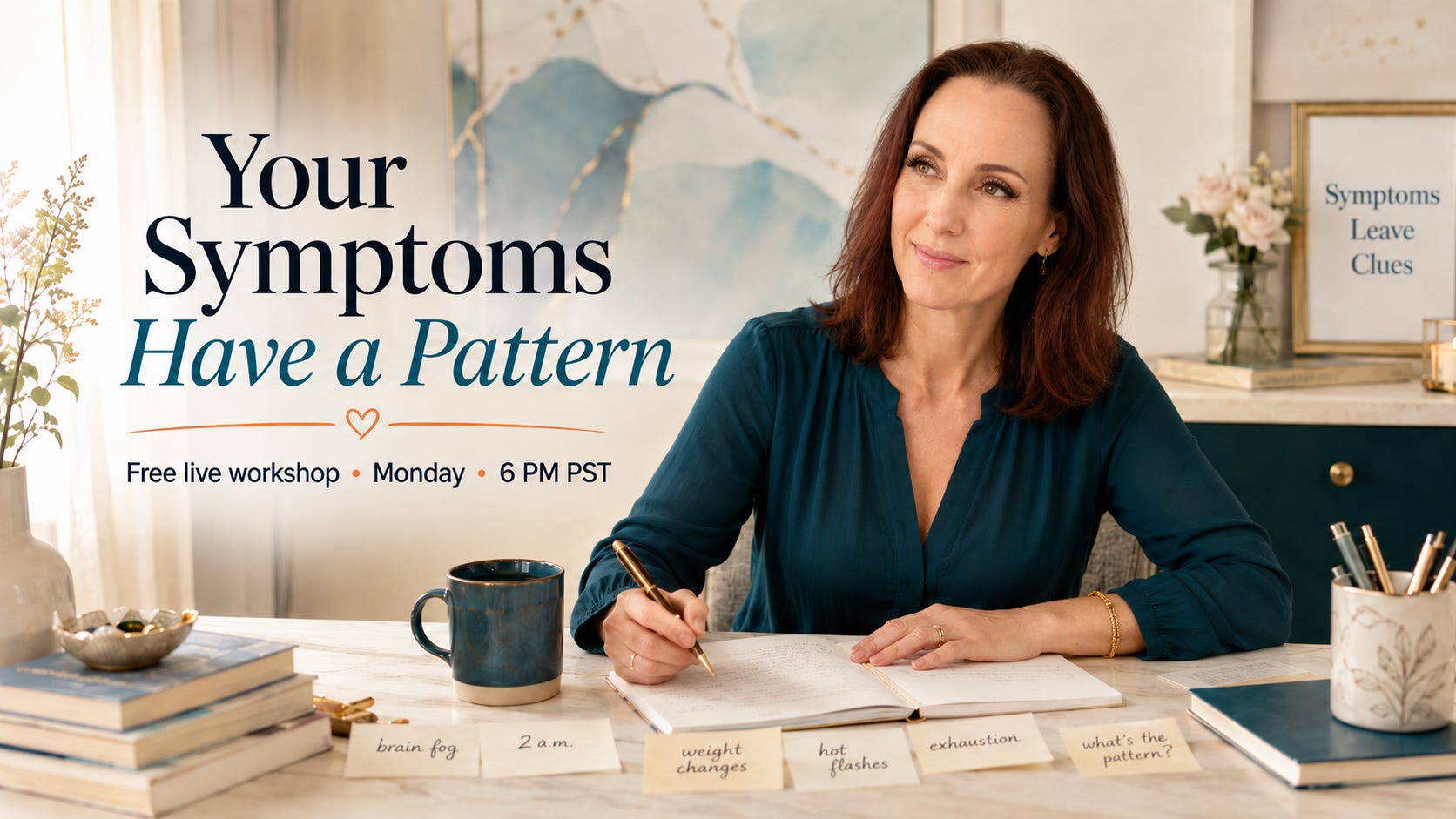
Maybe you’re wide awake at 2 a.m., staring at the ceiling and wondering why your brain suddenly wants to review every decision you’ve made since 1997, only to spend the next afternoon trying to keep your eyes open.
Or maybe you’ve become intimately familiar with the pantry at night despite eating what you thought were perfectly reasonable meals all day.
Then there are the other things.
The brain fog. The mood swings. The sleep changes. The weight that seems to have taken up permanent residence around your middle. The breast tenderness. The cravings. The fatigue. The night sweats. The feeling that your body suddenly changed the rules without bothering to give you the new instruction manual.
And because those symptoms don’t always show up neatly together, it’s easy to treat each one like its own separate problem.
Sleep problem? Work on sleep.
Weight gain? Change your diet.
Cravings? Try harder.
Mood swings? Stress less.
Hot flashes? Must be estrogen.
Except your body doesn’t operate in separate little departments.
That is where things start getting more interesting.
Perimenopause is bigger than estrogen
One of the biggest misunderstandings about perimenopause is the idea that everything happening in your body comes down to estrogen going down.
That is part of the story, but it is nowhere near the whole story.
Your hormones work together as a system. Estrogen, progesterone, testosterone, cortisol, insulin and thyroid hormones influence one another. Changes in one area can ripple into another, which is one reason two women of the exact same age can move through perimenopause and have completely different experiences.
One woman is waking up drenched at night and swinging between irritability and exhaustion.
Another is gaining weight around her middle, craving sugar and feeling wired even though she is completely depleted.
Another is struggling more with sluggishness, bloating, poor recovery or brain fog.
They are all in perimenopause.
But they are not necessarily experiencing the same pattern.
And if the pattern is different, blindly following the exact same advice makes very little sense.
This is why I want you to stop guessing
When something changes in our body, most of us immediately want to know what to do about it.
What should I eat?
What supplement should I take?
Should I fast?
Should I lift heavier?
Should I do more cardio?
Do I need hormones?
Do I need labs?
Those are reasonable questions. But there is a question I think needs to come first: What is my body showing me?
Because symptoms are information.
They are not a diagnosis, and one symptom by itself rarely tells us the whole story. But when we stop looking at each symptom in isolation and start looking for patterns, we get more useful information to work with.
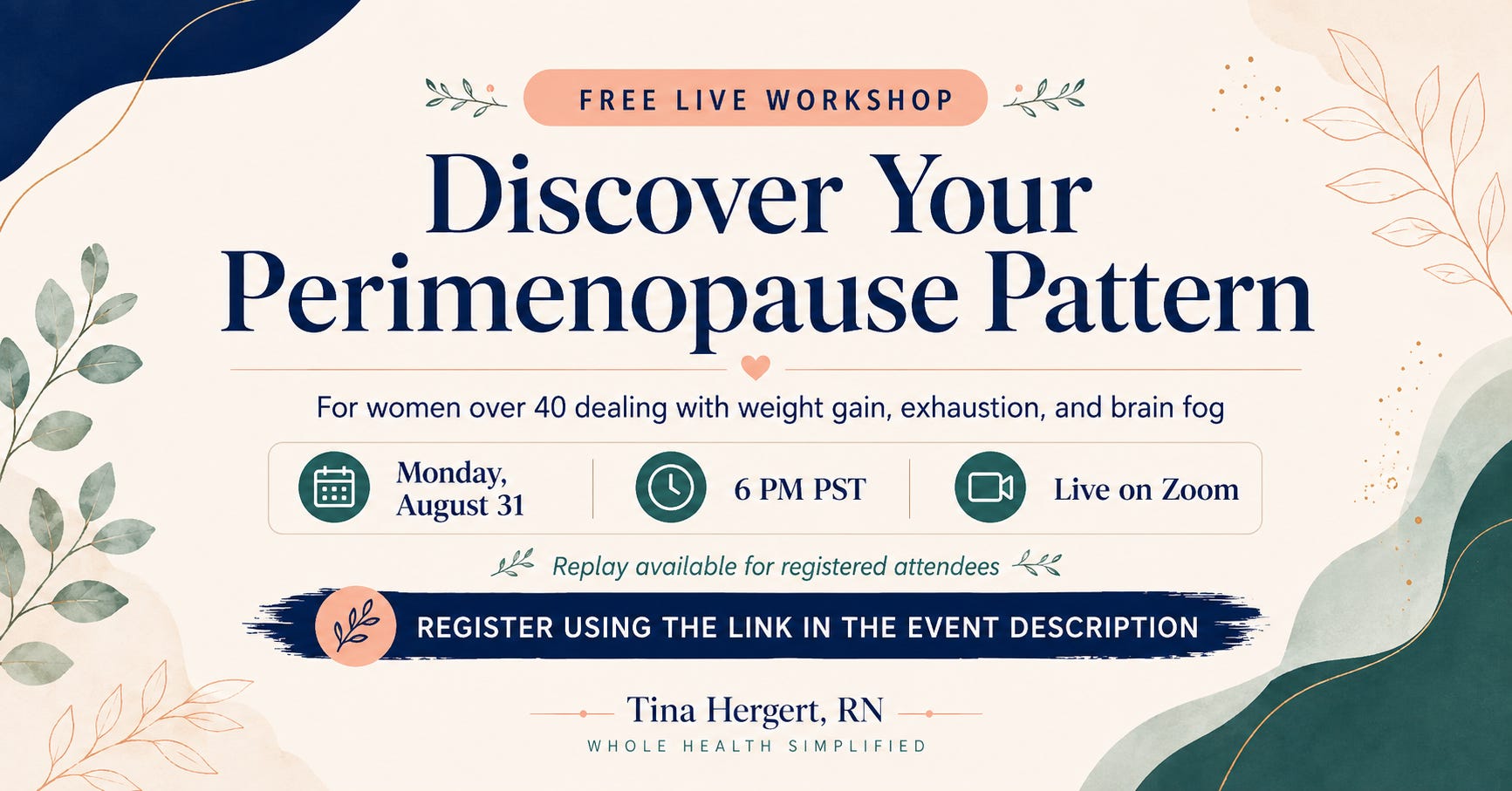
That is the entire reason I created my free workshop, Discover Your Perimenopause Pattern.
Here’s where we’re going Monday night
We’re going to start by laying the foundation for what is changing during perimenopause and why symptoms that seem completely unrelated can begin showing up at the same time.
Then we’re going to look at the hormones involved and how they work together rather than reducing the entire perimenopause conversation to one hormone.
From there, I’m going to help you start connecting your symptoms across the larger system, including the ovarian, adrenal and thyroid relationship that plays such an important role in how women experience this transition.
And then we get to the fun part.
You’re going to identify your own perimenopause pattern.
We’ll walk through the pattern quiz together so you’re not sitting there wondering whether you chose the “right” answer or trying to interpret everything on your own. By the end, you’ll have a clearer picture of which pattern most closely reflects what your body is showing you right now.
You might meet your inner Hot & Bothered.
You might recognize yourself immediately as a Cortisol Craver.
You may lean more Liver Lover or Mighty Mito.
And no, I am not putting you into a cute little hormone box and declaring that this is who you are forever.
Your pattern is a guide, not a rule. Women can have overlap between patterns, and your pattern can change as your physiology, circumstances and stage of perimenopause change.
The point is to give you a starting place.
Because “I feel terrible and I have no idea why” leaves you stuck.
“I’m beginning to see a pattern in what my body is doing” gives you somewhere to go next.
And that changes the questions you ask
This is the part I care about most.
Understanding your pattern is not about handing you another list of things you are supposed to fix.
It is about helping you become more informed about your own body.
You start noticing connections.
You start asking more specific questions.
You start walking into healthcare conversations with more context than, “I don’t feel like myself.”
You have language.
You have observations.
You have a better idea of what deserves a closer look.
And instead of throwing every diet, supplement, workout plan and hormone hack at your body hoping something sticks, you begin making decisions from information rather than frustration.
Perimenopause is not only a transition to survive.
It can also be an invitation to understand your body in a way you may never have been taught to understand it before.
That is what I want to help you begin doing Monday night.
Come join me
Discover Your Perimenopause Pattern is happening Monday, August 31 at 6 PM PDT on Zoom.
It’s free, and if you register but cannot make it live, you’ll still receive access to the replay.
Click the button below to register through Zoom, and I’ll see you there.
Bring your symptoms.
Bring your questions.
And bring the part of you that has been wondering whether all these seemingly random changes might be connected after all.
Because they might be telling us a lot more than you think.