


Every perimenopause checklist on the planet starts with the same clue… your period gets weird. It shows up early, then late, then not at all, then twice in one month just to keep you humble.
Great clue, very helpful. For a lot of women, it’s the one that finally gets somebody in a white coat to say the word perimenopause out loud.
Now let’s talk about the women whose period can’t tell them a thing.
She had a hysterectomy at 32. She’s had a hormonal IUD for years and barely bleeds. She’s on the pill, getting a tidy little bleed every 28 days that has nothing to do with what her ovaries are up to. Or she’s 38, cycling like clockwork, and can’t figure out why her sleep fell apart and her patience went right along with it.
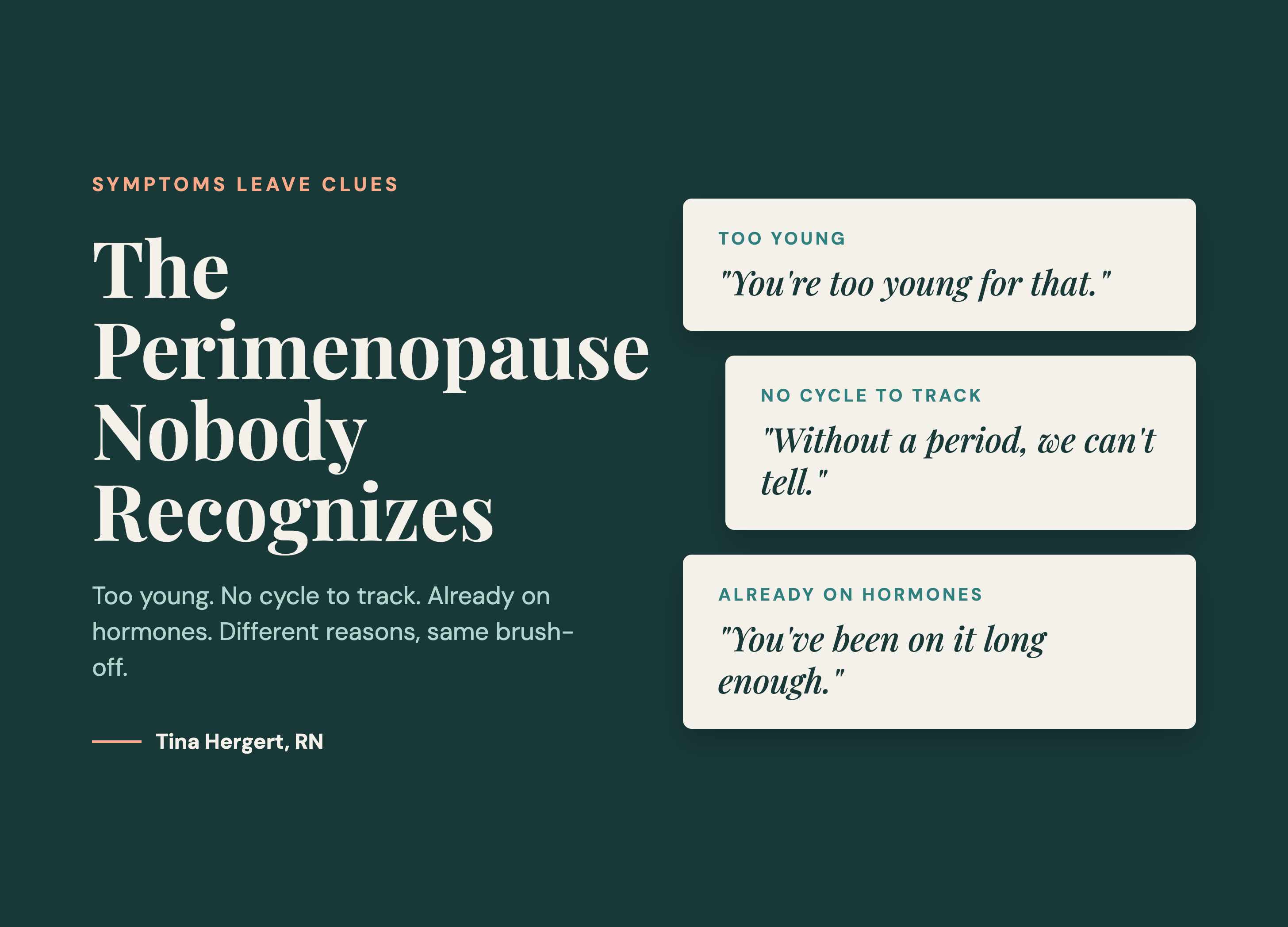
Her hormones are shifting just like everyone else’s, she just didn’t get the memo. And when she finally goes looking for answers, she hears some version of the same thing. You’re too young. You don’t have periods, so we can’t tell. You’re on birth control, so it can’t be that. You’ve been on hormones long enough.
Different words. Same door closing in her face.
I promised in my last article that this one was coming. If you’ve never fit the textbook picture and you’ve been brushed off because of it, pull up a chair. This one’s for you.
I didn’t get the clue either
I had a hysterectomy in my early thirties. I kept my ovaries, so I wasn’t thrown into menopause and didn’t need hormones afterward. My ovaries kept right on working. I just didn’t have a period anymore to tattle on them.
Fast forward to my forties. I had never heard the word perimenopause. Not once. Nobody in my life was talking about it, and nobody in a white coat was either. It wasn’t exactly dinner table conversation back then.
Looking back, the clues were everywhere. The irritability, the mood swings, the rage that came out of nowhere and scared me a little. I’ve had migraines my whole life, and they cranked up to a whole new level. Then there was sleep. First I couldn’t fall asleep, so I blamed stress. Then I could fall asleep just fine and couldn’t stay there. My joints started aching, I was gaining weight, losing words and honestly, felt like I was losing myself in the process.
Every symptom came with a perfectly reasonable excuse. Stress. Busy. Getting older. Not one of them pointed to a period, because I didn’t have one to point to.
I’ve already told the story of what happened years later, when I walked into my own doctor’s office asking for answers and still had to push. [I’m a nurse, and I Still Almost Missed My Own Perimenopause.] This piece is about the part before that. The years when you don’t even know what to ask, because the one sign everybody’s watching for isn’t there.
Hysterectomy, ovaries kept, and the part nobody mentions
This is my group, and there’s something I didn’t learn until I went digging into the research for my book.
Several studies have found that women who had a hysterectomy but kept their ovaries reached menopause earlier, on average. A five-year study of more than 500 women found the hysterectomy group hit menopause about 3.7 years sooner than women who didn’t have the surgery. Women who also lost one ovary got there 4.4 years earlier than those who kept both. Another study of nearly 900 women found the odds of the ovaries shutting down within four years were almost double after a hysterectomy. And a 2023 review of 14 studies found exactly the hormone markers you’d expect when ovaries are winding down, lower AMH, higher FSH, and lower inhibin B, with the biggest effect in women over 40.
So what’s going on? One leading theory comes down to plumbing. A 2025 review estimates the uterine artery supplies roughly 50 to 70 percent of the blood flowing to your ovaries. Take out the uterus, and your ovaries may lose part of their blood supply. Less blood flow, and they may clock out early.
In fairness, not every study agrees. A 2023 analysis from SWAN, one of the biggest long-term studies of women going through menopause, didn’t find a faster drop in AMH after hysterectomy with the ovaries kept. So treat this as a real possibility worth knowing about, not a done deal.
Now think about what that means for you. Your perimenopause may show up earlier than anyone expects, with no period to flag it. That’s two strikes before you even walk in the door. Then you describe your symptoms, and you get a shrug, because without a period nobody’s quite sure what they’re looking at.
If you don’t know exactly what was removed during your surgery, find out. Ask for your operative report. Both ovaries, one, or none changes the whole conversation.
When your period is on autopilot
A hormonal IUD, the pill, and an endometrial ablation all have one thing in common. They mess with your bleeding, which means they can hide the very thing everybody’s waiting for.
A hormonal IUD often makes periods much lighter, and for some women it stops them altogether. Hard to notice your cycle going rogue when you’re barely bleeding.
The pill is sneakier. That monthly bleed on the pill isn’t a true period. It’s a withdrawal bleed from the break in hormones, and it shows up right on schedule no matter what your ovaries are doing behind the curtain. You can be knee-deep in perimenopause and still have a perfectly punctual “period.”
An endometrial ablation, a procedure that destroys the lining of the uterus to stop heavy bleeding, often leaves periods much lighter or eliminates them completely. Same problem, different route.
None of these are bad choices. Plenty of women use them for very good reasons, and in perimenopause the pill or a hormonal IUD can be part of managing symptoms. The problem starts when a provider points at your birth control and decides it can’t be hormones. Even the UK’s national clinical guideline warns doctors that menopause can be hard to recognize in women taking hormonal treatments. Hard to recognize is a long way from impossible. When your bleeding is on autopilot, your symptoms are the clues that count.
“You’re too young for that”
If I could retire one sentence from every exam room in the country, it would be this one.
Here’s the math nobody does out loud. The average woman reaches menopause around 51. Perimenopause can run for ten years, sometimes more, before that. So symptoms at 42 aren’t early. They’re right on schedule. And for plenty of women, they start in the late thirties.
I’m hearing from more and more of those women in my own work. Women in their late thirties and early forties whose sleep became irregular, whose anxiety showed up out of nowhere, whose cycles started shifting, and whose bodies stopped responding to the same food and workouts that worked just fine last year. They’re smart. They’re paying attention. They know something changed.
And they walk out with everything except the word perimenopause. It’s stress. It’s your kids. It’s your job. Here’s something for your sleep. Here’s something for your anxiety. Have you tried cutting back on the wine? Your thyroid looks normal, so you’re fine.
None of it asks the question that matters. Could this be perimenopause?
This is one of the biggest dismissal traps I see, because she doesn’t just lose an answer. She loses years. Years of thinking she’s failing at sleep, failing at stress, failing at her own life, when her hormones were shifting the whole time and nobody bothered to notice.
For some women, it’s more than an early start. Premature ovarian insufficiency, when the ovaries stop working normally before 40, affects somewhere between 1 and 5.5 percent of women worldwide, depending on the study. That’s not rare enough to wave off. Losing estrogen that early can affect your bones, your heart, and your brain for decades. This is also one place where labs earn their keep. Before 40, guidelines call for blood work to confirm it, usually FSH checked twice a few weeks apart. If you’re under 40 and your periods are getting irregular or disappearing, you deserve that workup, not a pat on the head.
And if you’re told you’re too young, you can try this:
I know I’m younger than average. Can we look at whether this could be perimenopause, or rule it out, instead of assuming it can’t be?
You’re not too young to ask. You may be right on time to catch it early.
Surgical menopause and the “you’ve been on it long enough” speech
Then there’s the woman whose ovaries were removed, often along with a hysterectomy, years before her body would have gotten there on its own. She never got a perimenopause. She went from normal hormone levels to almost nothing overnight. No warm-up, no gradual taper. Surgical menopause is abrupt, and the symptoms can hit like a freight train.
Many of these women have been on hormone therapy for years, and that lines up with what The Menopause Society recommends. For women who go through menopause early, its position is that hormone therapy can be used until at least the average age of natural menopause, unless there’s a reason not to.
Here’s where the dismissal sneaks in. She reaches 51 or so, and somebody decides it’s time to come off. Or she turns 60 and gets the old “you’ve been on it long enough” speech. But she started hormones right when she lost her own, and the timing research from my last article works in her favor. The Menopause Society also says hormone therapy doesn’t need to be routinely stopped at 60 or 65. Whether to continue, adjust the dose, or change the route is an individual conversation, not a birthday rule.
Her needs can change, too, even if she’s been on the same prescription for 15 years. The dose that was right at 35 may not be right at 55. If nobody’s looked at that in a while, it’s fair game to bring up.
What to watch when there’s no period to watch
Symptoms leave clues. When your period is out of the picture, the rest of them don’t disappear. They just get quieter and easier to explain away, which is exactly what I did for years.
Watch your sleep, especially if trouble falling asleep turns into trouble staying asleep. Watch your mood, especially irritability, rage, or anxiety you never used to have. Watch headaches or migraines that change in pattern or intensity. Watch for joint aches that don’t match what you did that day, brain fog, night sweats, and a body that suddenly stops responding to the routine that’s worked for years.
And then there are the weird ones nobody warns you about. A frozen shoulder, phantom smells, like smoke or something burning that nobody else in the room can smell, ringing in your ears, feeling dizzy or a little off balance, a burning tongue or mouth with no obvious cause. Some of these have research pointing to a hormonal link. Others are mostly what women report, and the science hasn’t caught up yet. All of them are worth bringing up, especially when they show up alongside the more familiar symptoms.
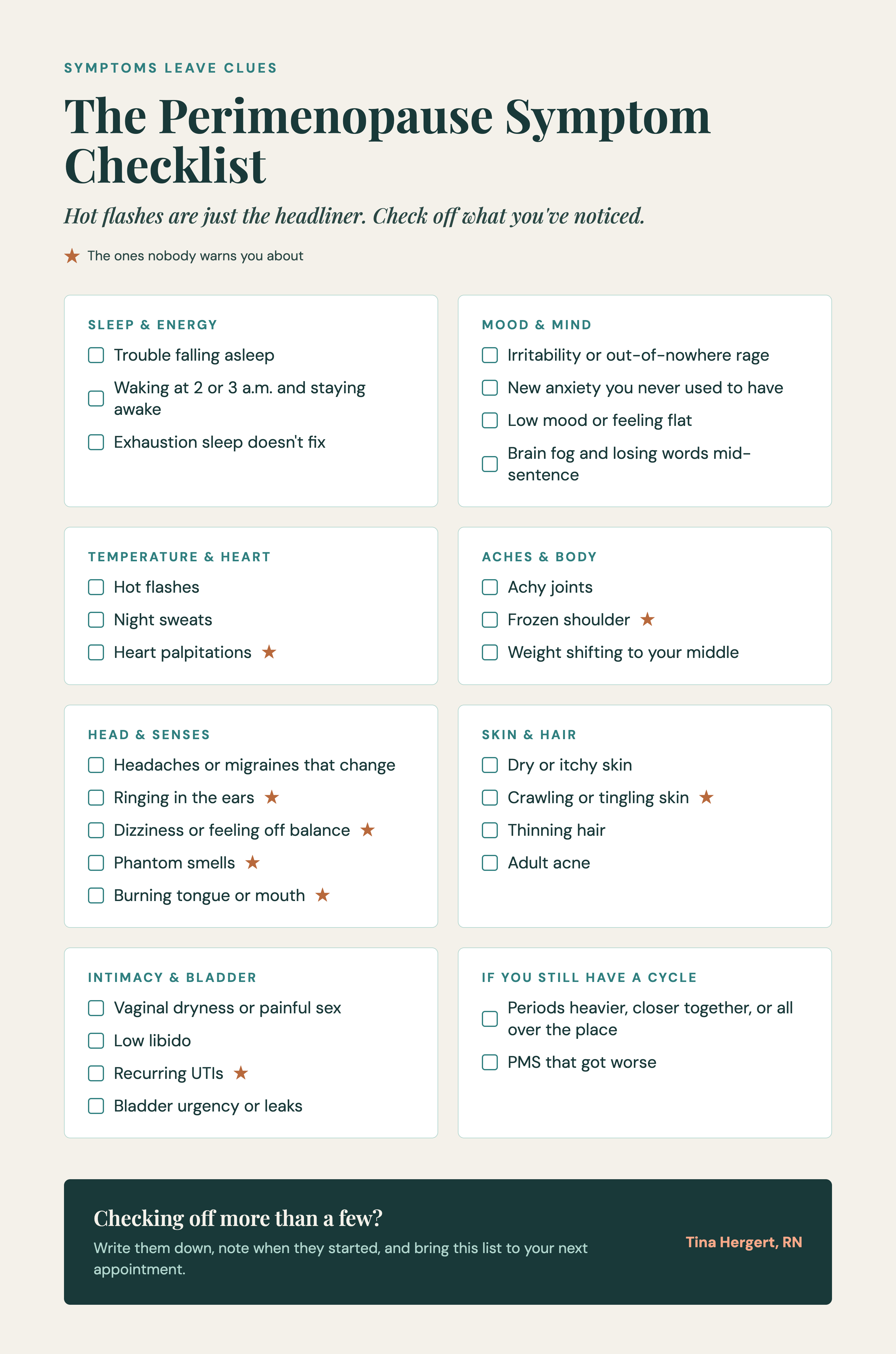
Then write it down. When you don’t have a cycle to anchor to, a simple symptom log becomes your cycle. The date, how you slept, your mood, headaches, aches, anything that felt off. A few months of notes shows a pattern no eleven-minute appointment ever could.
Bring that log into the room, along with your surgical history and any hormonal medications or devices. Data is a whole lot harder to brush off than “I just don’t feel like myself.” Then try a few better questions:
Could these symptoms be perimenopause, even though I don’t have a period to track?
I had a hysterectomy and kept my ovaries. Could they be winding down earlier than expected?
I’m on the pill (or have a hormonal IUD). Could it be masking changes in my cycle?
I’ve been on hormone therapy since my surgery. Are my current dose and route still the right fit for me now?
This is exactly the kind of conversation I want to have with you live.
I’m putting together a hormone workshop where we’ll cut through the fear, walk through the current evidence on benefits and risks, and get into the situations that don’t fit the textbook, like yours. It will live inside the Vital Library, my paid tier.
The Vital Library is normally $149 for the year. That covers the hormone workshop plus every monthly workshop for the 11 months after it. You also get the Make It Make Sense episodes already waiting for you, including HRT 101 and The Hormone Study That Scared a Generation of Women, as well as a workshop replay from September, Discover Your Perimenopause Pattern.
Here’s the part you’ll want to know: I’m opening a special discount on the Vital Library for this workshop launch, and it won’t be around long.
I’ll post all the details here soon, including the moment it goes live. Make sure you’re subscribed so it lands in your inbox and you don’t miss the window.
Coming next week
Next week, I’m tackling a condition hiding in plain sight for a lot of women who don’t fit the box. It affects more than 1 in 8 women. In one study, about two thirds of the women who had it had never been diagnosed. And this year, it got a brand new name. If your cycles, your weight, or your blood sugar never seemed to follow the rules, you’ll want to read that one.
You were never too young, too done, or too complicated to be taken seriously. You just didn’t come with the sign everyone was trained to look for. That’s a gap in the training, and you’ve been the one paying for it.
Tell me in the comments which box you didn’t fit. No period to watch, too young, surgical menopause, or something else entirely. Somebody reading needs to know she’s not the only one.
This article is for education and awareness. It isn’t medical advice, and it doesn’t replace a conversation with a qualified provider who knows your full history.
Sources
Farquhar CM, et al. The association of hysterectomy and menopause: a prospective cohort study. BJOG. 2005;112(7):956-962. https://researchspace.auckland.ac.nz/handle/2292/25709
Moorman PG, et al. Effect of hysterectomy with ovarian preservation on ovarian function. Obstetrics & Gynecology. 2011;118(6):1271-1279. https://pmc.ncbi.nlm.nih.gov/articles/PMC3223258
Effect of hysterectomy on ovarian function: a systematic review and meta-analysis. Journal of Ovarian Research. 2023. https://doaj.org/article/1d367ee9b96241bbb71162538af87f57
Chen Y, Min L. Post-hysterectomy ovarian consequences: mechanisms, risks, and clinical management strategies. A narrative review. Clinical and Experimental Obstetrics & Gynecology. 2025;52(12):44674. https://doi.org/10.31083/CEOG44674
Santoro N, et al. Anti-Müllerian hormone level decline in patients undergoing hysterectomy with and without oophorectomy compared with natural menopause. Obstetrics & Gynecology. 2023;141:331-340. https://reliasmedia.com/articles/do-anti-müllerian-hormone-levels-decline-more-rapidly-after-hysterectomy-with-ovarian-conservation
National Institute for Health and Care Excellence. Menopause: diagnosis and management (NG23), section 1.2. https://www.nice.org.uk/guidance/ng23/resources/menopause-diagnosis-and-management-1837330217413
Rostami Dovom M, et al. Prevalence of premature ovarian insufficiency and its determinants in Iranian populations. BMC Women’s Health. 2021;21:79. https://link.springer.com/article/10.1186/s12905-021-01228-1
The 2022 hormone therapy position statement of The North American Menopause Society. Menopause. 2022;29(7):767-794. https://pubmed.ncbi.nlm.nih.gov/35797481/
Teede HJ, et al. Polyendocrine metabolic ovarian syndrome, the new name for polycystic ovary syndrome: a multistep global consensus process. The Lancet. 2026. https://www.thelancet.com/journals/lancet/article/PIIS0140-6736(26)00717-8/fulltext
March WA, et al. The prevalence of polycystic ovary syndrome in a community sample assessed under contrasting diagnostic criteria. Human Reproduction. 2010;25(2):544-551. https://digital.library.adelaide.edu.au/items/04146ef0-3922-4cbf-b38f-e685c16e37b3