

You described it as clearly as you could.
The night sweats that soak the sheets. The rage that comes out of nowhere and leaves you wondering who that woman was. The words that vanish halfway through a sentence, the 3 a.m. wake-ups, the anxiety you never had at 35.
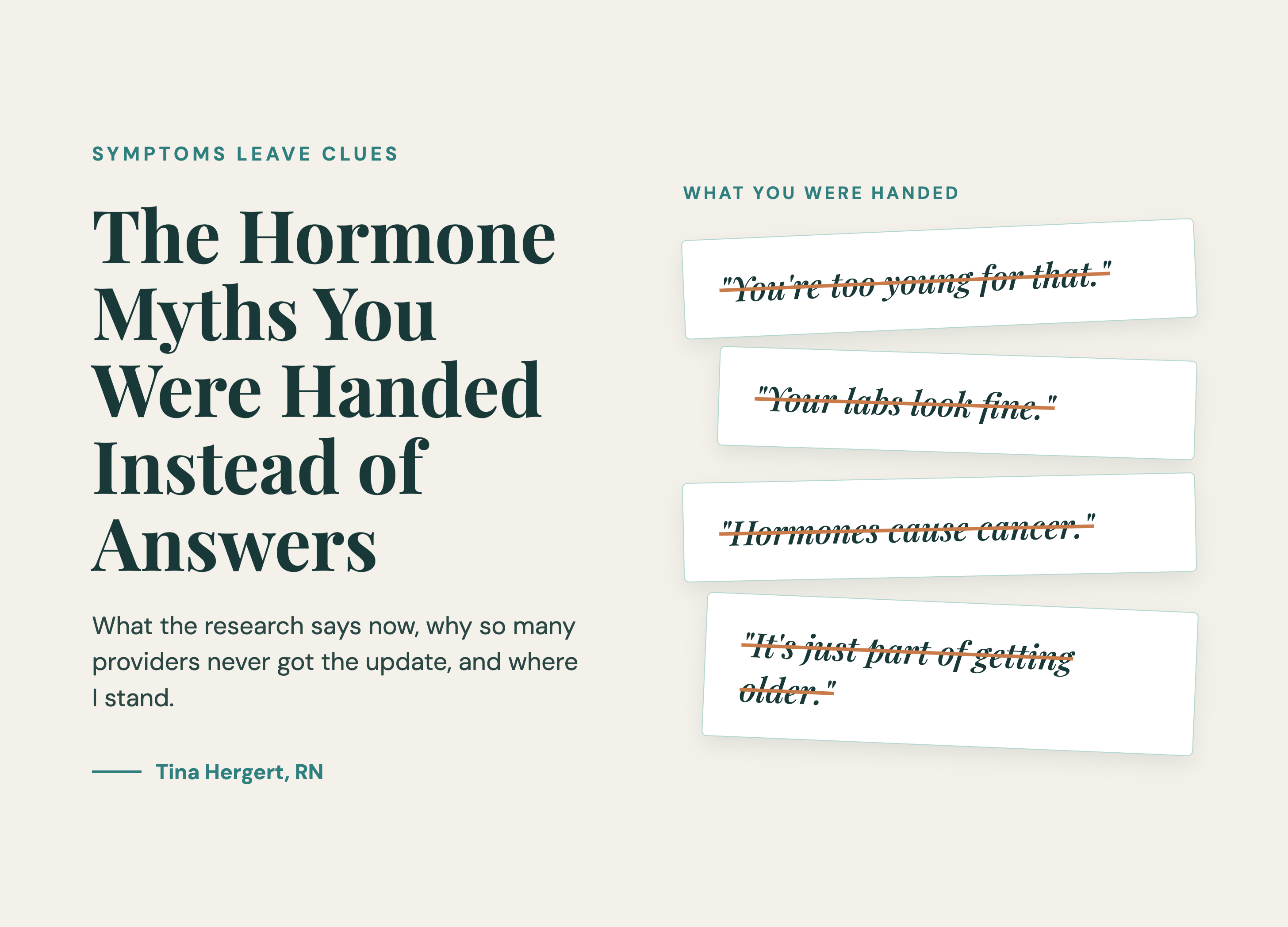
And you walked out with one of a handful of answers. You’re too young for that, you’re still having periods. Your labs look fine. Hormones cause cancer, so let’s not go there. Or the classic, this is just part of getting older.
Maybe you got all four in one visit.
If any of that happened to you, I want to be very clear before we go any further. You weren’t being dramatic, and you weren’t asking for something dangerous. You walked into a gap in women’s healthcare that’s more than twenty years wide, and you are far from the only woman who fell into it.
Let’s start with the gap, because it explains everything else.
Most doctors were never taught this
I’m not throwing anyone under the bus here. Most of the providers women see about menopause were never formally trained in it.
In a 2022 national survey of OB/GYN residency program directors, published in the journal Menopause, only 31.3% said their program had a menopause curriculum at all. Fewer than 3 in 10 gave residents dedicated time in a menopause clinic. And the programs that did teach it gave it five lectures a year or less.
Five lectures. For a transition every woman with ovaries goes through, and then lives on the other side of for roughly a third of her life.
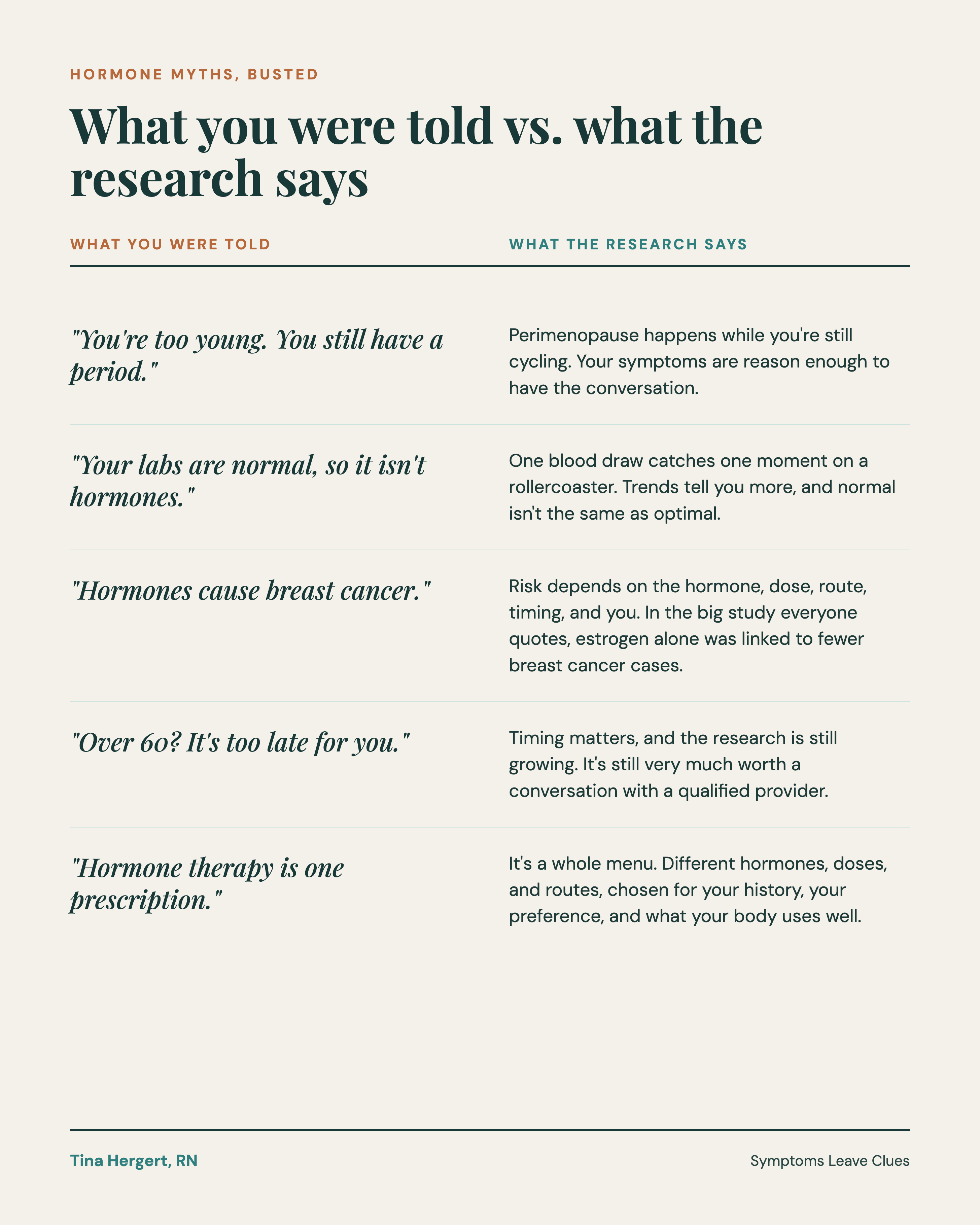
This isn’t new, either. Back in 2013, only about 1 in 5 OB/GYN residents said their program had formal menopause education. A decade later it has barely moved, and those are the specialists. A 2017 survey of residents in family medicine, internal medicine, and OB/GYN, the doctors most women see, found that only 6.8% felt adequately prepared to care for women going through menopause. That’s fewer than 1 in 10.
So when your doctor hesitated, handed you a prescription for something else, or told you to wait it out, there’s a good chance she was doing exactly what she was taught. Which was close to nothing. Call it what it is, a training gap, and you’re the one who’s been paying for it.
And that gap is exactly where these myths took hold.
Myth 1: You’re too young. You still have a period.
This is the one I hear most, and it makes me crazy.
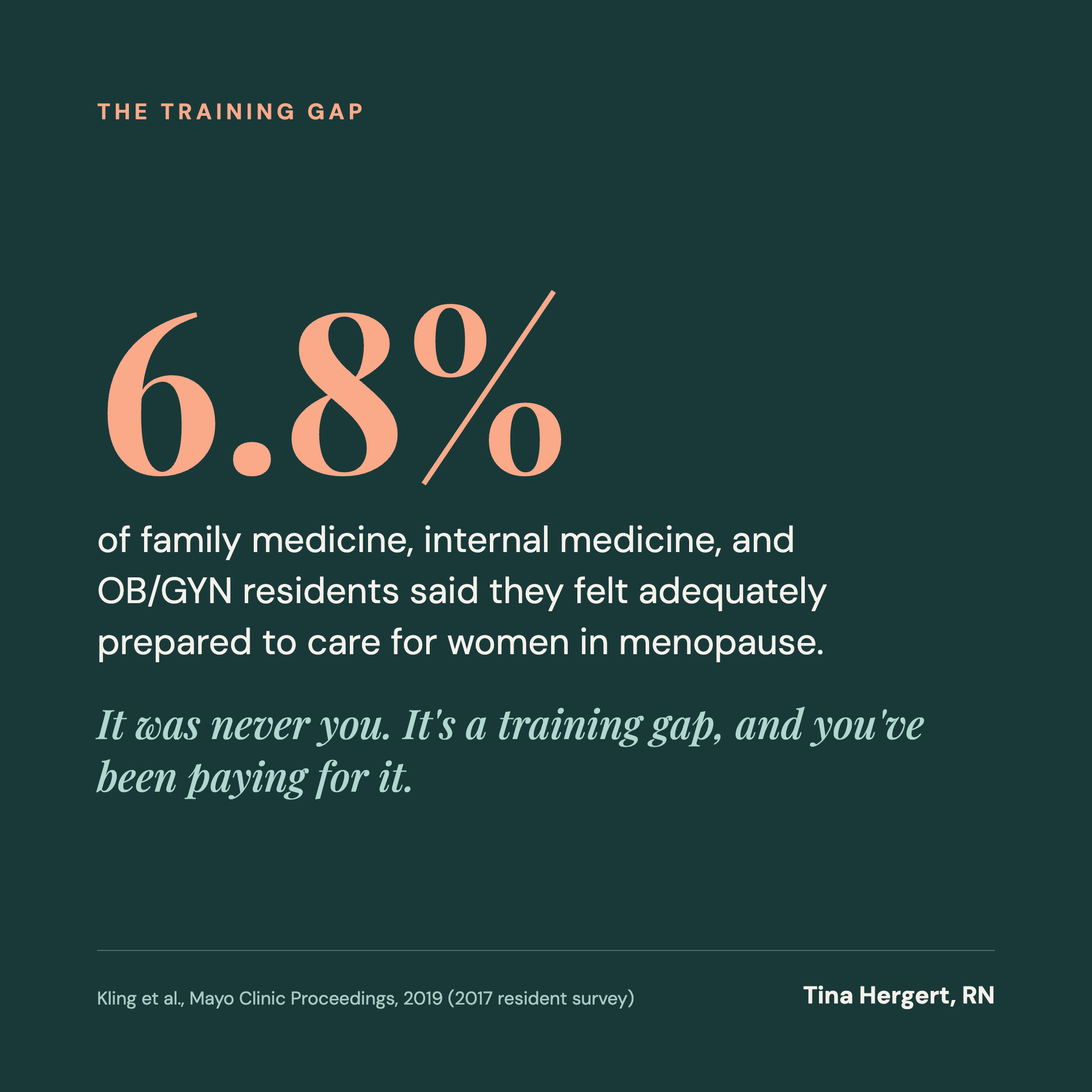
Perimenopause happens while you’re still cycling. That’s what the word means. It’s the stretch of years before your final period when your hormones start swinging, and for a lot of women the symptoms show up long before the periods stop.
The guidelines don’t make you wait for your last period to be taken seriously. The UK’s national clinical guideline (NICE) tells doctors to diagnose perimenopause in otherwise healthy women over 45 based on symptoms and changing cycles, with no lab test required. And The Menopause Society’s 2022 position statement says that for women under 60 or within 10 years of menopause onset, with no contraindications, the benefit-risk ratio of hormone therapy for bothersome symptoms is favorable. That’s a window measured by age and timing. Nowhere does it say you have to be done bleeding first.
The word diagnose in that guideline makes me cringe. Perimenopause and menopause are a natural life transition. We don’t diagnose puberty. We don’t diagnose the other seasons of a woman’s life. But if putting a name on it is what it takes for women to be seen, taken seriously, and cared for appropriately, that’s a trade-off I’m willing to make.
And when perimenopausal women are offered something, it’s often a birth control pill or a hormonal IUD, and the conversation ends there. Those have their place. They’re one item on the menu, but you deserve to see the rest of it.
And if you don’t have a period to watch change at all, or your symptoms showed up in your late 30s, you don’t fit the textbook box, and you’re often the last one to be recognized. Your story deserves its own article, and it’s coming next.
Still cycling and still suffering is still a reason to have the conversation.
Myth 2: Your hormone labs came back normal, so it isn’t perimenopause.
Perimenopause is a rollercoaster. Estrogen and progesterone can swing hard from one week to the next, sometimes day to day. A single blood draw catches one moment on that ride. It can look perfectly normal on a Tuesday and tell you nothing about the Thursday you couldn’t get out of bed.
That’s exactly why NICE tells doctors not to use an FSH blood test to diagnose perimenopause or menopause in women over 45. Your symptoms are the evidence.
I’m a Test, Don’t Guess gal all day long, and I’ll never tell you labs don’t matter. They matter a lot for the bigger picture, like your thyroid, your blood sugar, and your iron. But a “normal” estradiol in a 46-year-old who soaks her sheets every night doesn’t rule hormones out. It means the test caught her on a good day.
Where labs earn their keep in perimenopause is in the trend. One number tells you almost nothing. Several over time show you which direction things are heading.
Once you’re closer to menopause, or past it, the wild swings settle down and testing gets a lot more useful. Hormone therapy dosing is usually guided by symptoms, and that works when symptom relief is the goal. But a growing body of research is looking at what estrogen does for aging well, because you have estrogen receptors all over your body, in your bones, muscles, heart, brain, and gut. If you’re replacing hormones for longevity as well as for symptoms, I believe tracking your levels over time matters. What counts as an optimal range is still debated depending on which research you read, so that’s a conversation to have with your provider.
And normal and optimal aren’t the same thing. If you’ve been told “your labs are normal” about anything, I wrote a whole piece on what that word means and who decided it. You can read it here: Your Labs Are Normal. That Doesn’t Mean You’re Healthy.
Myth 3: Hormone therapy causes breast cancer.
This is the fear that kept a generation of women off hormones, so it deserves a straight answer.
The Women’s Health Initiative, the big study everyone still quotes, ran two separate hormone trials. The one using estrogen plus a synthetic progestin showed a breast cancer risk signal with longer use. The FDA itself now describes that original finding as a statistically non-significant increase in breast cancer diagnosis. Longer follow-up did find more diagnoses with that combination, with no difference in breast cancer deaths. That signal deserved attention, but it was not the whole story.
In the trial using estrogen alone, in women who’d had a hysterectomy, breast cancer went down. After about 20 years of follow-up, published in JAMA in 2020, the women on estrogen had fewer breast cancer diagnoses than the women on placebo, 238 versus 296. And fewer of them died from breast cancer, 30 versus 46.
Most women have never heard that half of the story. What the public heard in 2002 was that hormones cause breast cancer, and that’s the only line that stuck.
The real picture is more specific. Risk depends on which hormones, what dose, what route, when you start, how long you use them, and whether a progestogen is part of it. The Menopause Society says exactly that. A personal history of breast cancer or a gynecologic cancer doesn’t automatically take hormone therapy off the table either, and as the research gets better and more inclusive, some of what we’re learning is encouraging. That’s a conversation for your oncology team and a menopause-trained provider who knows the current data.
Myth 4: The big study proved hormones are dangerous for everyone.
Back to 2002. When the WHI results hit the news that July, women panicked, and so did their doctors. Within a year, prescriptions for Prempro, the combination pill used in the trial, dropped by 66%.
A Kaiser Permanente survey from that period found that 93% of women had heard of the WHI. Most of them, 64%, didn’t know what it found. And more than half had tried to stop their hormones anyway.
That’s fear making the decision.
Here’s what got lost. The women in that study averaged 63 years old, well past the age most women go through menopause. And they took one specific combination, horse-derived estrogen plus a synthetic progestin, which is far from the only option women have today.
It took more than twenty years for the label to catch up. On November 10, 2025, the FDA announced it was removing the boxed warning language about heart disease, breast cancer, and probable dementia from menopausal hormone therapy, and in February 2026 it approved the first six updated labels. The warning about endometrial cancer for estrogen taken without a progestogen stays, and it should.
The professional societies welcomed the change, with a caveat. The Menopause Society fully agreed with removing the warning from low-dose vaginal estrogen. For systemic therapy, it stressed that risks are low for younger, healthy women starting closer to menopause and higher for women who start later.
Some critics went further and argued the decision rested more on opinion than on new safety data. I’m telling you all of it because you deserve the whole picture, not a fresh set of headlines pointing the other direction. The label changed. Your individual risk still deserves an individual conversation.
And there’s more to this story than a warning label, including what the long-term follow-up found 18 years later. That part barely made the news.
Myth 5: Lowest dose, shortest time, and off by 60.
For two decades, “lowest effective dose for the shortest duration” was gospel. Plenty of women were told to stop at five years, or at 60, no matter how they felt.
The FDA’s 2025 labeling change dropped that mandate. The Menopause Society was already there. Its 2022 position statement says hormone therapy doesn’t need to be routinely stopped after 60 or 65, and can be continued for ongoing symptoms, quality of life, or bone protection after a real conversation about benefits and risks.
What the research does point to is timing. Starting within 10 years of menopause or before 60 is where the balance looks best. Starting later carries more absolute risk of heart disease, stroke, blood clots, and dementia. You deserve to know that before you decide, and it’s one more reason this conversation belongs on the calendar sooner rather than later.
Here’s the part I don’t want anyone to miss. Those age and timing windows come from the studies we have, and a lot of that foundation was built on one study using one combination of hormones. As more women speak up and seek care, more research is being done with the hormones and routes women use today. Guidelines get revised as new evidence comes in, and I expect these will too.
So if you’re over 60, or more than 10 years past your last period, please don’t read this and think, great, I’m still not a candidate. It’s still very much worth a conversation with a qualified provider about whether hormone therapy could be an appropriate addition, or at least something worth trying, often at a lower dose.
If you can’t find a provider near you who’s trained in this, reach out to me. I’m building a database of menopause-informed providers so more women can find one. And if you’re a qualified provider reading this and you’d like to be included, I’d love to hear from you too. Email me at tina@tinahergertrn.com
Myth 6: Bioidentical means compounded, and compounded means safer.
This one comes from the other side of the internet.
“Bioidentical” means the hormone has the same molecular structure as the one your body makes. That’s all it means. It says nothing about whether it came from a plant, the pharmacy down the street, or a pellet.
Plenty of bioidentical options are FDA-approved. Estradiol patches, gels, and pills. Oral micronized progesterone. You can pick those up at a regular pharmacy.
I once asked a provider point blank whether she had bioidentical estradiol or progesterone on the formulary. She told me there was no such thing as bioidentical hormones. Then she looked it up, and there it was, bioidentical estradiol sitting right there in her own system. Remember that gap? Here was another example of it.
Compounded hormones are custom-mixed and aren’t regulated by the FDA the same way. A 2020 report from the National Academies of Sciences, Engineering, and Medicine found that most marketing claims about their safety and effectiveness aren’t backed by well-designed studies, and that the lack of standardization raises the chance of getting too much or too little. Compounding has a place for women who can’t use an approved product. It isn’t automatically safer because someone on your feed called it natural. Sourcing matters here.
Myth 7: Hormone therapy is one prescription.
Most women picture one thing when they hear HRT. A pill, maybe a patch, one dose, take it or leave it.
It’s a whole menu. There’s which hormones you use, from estrogen to progesterone to testosterone. There’s whether it works throughout your body or stays local, like low-dose vaginal estrogen for dryness, painful sex, or recurrent UTIs. And there’s how it gets in, by pill, patch, gel, cream, or injection. That choice should come down to your health history, your preference, and how well your body uses that form. Some women do much better on one route or form than another, and if it isn’t working for you, it doesn’t mean give up, it means ask your provider about a different route, dose, or both.
That’s why the birth-control-only conversation from Myth 1 matters so much. For women who are still cycling, a patch or progesterone rarely comes up.
That’s a miss, because progesterone is often one of the first hormones to drop in perimenopause. Your body makes most of it after you ovulate, and as ovulation gets less reliable, progesterone falls while estrogen can still spike high. That widening gap is linked to poor sleep, new anxiety, and mood swings that feel like a stranger moved into your body. The anxiety you never had at 35 may have a hormonal piece to it.
For some women who are still cycling, nightly oral progesterone on its own takes the edge off a lot of those symptoms. Some take it for about two weeks of the month, timed to their cycle, to mimic their natural rhythm more closely. That’s one example of what opens up when someone shows you the whole menu.
Most women get handed the one option their provider knows best and walk out assuming it was the only one.
Knowing the myths is step one. Walking into your next appointment and having a different conversation is step two.
Paid members of the Vital Library already have two episodes of Make It Make Sense, my paid podcast, that pick up where this leaves off. In HRT 101, I walk through the entire menu, the routes, the forms, what to expect in the first few weeks, and which side effects mean call your provider. In The Hormone Study That Scared a Generation of Women, I take you inside the WHI itself, what it was designed to test, what the 18-year follow-up found, and the timing piece most women never hear about. Both come with questions you can carry into your next appointment. The Vital Library has additional guides and resources for those who want to go even deeper. At only $79 for the entire year, it’s more than worth it.

Where I stand
You deserve to know exactly where the person writing this stands.
I’m a postmenopausal woman, I’ve had a hysterectomy, and I use hormone therapy. I chose a low-dose bioidentical estradiol patch after looking at my own history, my own risks, and my own goals. I have a history of migraines, so the route mattered to me.
I also had to fight for my progesterone. My provider told me flat out I didn’t need it because I don’t have a uterus. Cool story, but I didn’t ask for a uterus status update. I asked for progesterone, because I wasn’t sleeping and my mood could definitely use some help! Progesterone does a lot more than protect a uterine lining. I got it, begrudgingly.
I’m a nurse. I was already training in hormone and metabolic health when I sat in that exam room, and I still had to push twice. If it took that much for me, the problem was never you.
And I fully support the woman who looks at the same evidence and decides it’s not for her. Some women can’t use hormones for medical reasons. Some simply don’t want to. Both are valid. Her body, her call.
What I won’t support is a woman being scared off by a twenty-year-old headline, or pushed into something by a reel.
This decision was never supposed to be made by fear. Not fear of hormones, and not fear of missing out on them. It’s supposed to be made by you, informed, alongside a provider who knows the current evidence and takes your symptoms seriously.
I’ve seen this from both sides of the chart. I’ve stood in the room as the nurse while a woman was told her symptoms were normal. I’ve sat on the table as the patient and heard the same thing about mine. Women who walk into that room informed change what the next woman gets to expect.
Now I want to hear from you. Drop the myth you were handed in the comments. “You’re too young.” “Your labs are fine.” “Hormones cause cancer.” Whatever it was, put it there. I promise you’re not the only one who heard it.
And if you want to go further than one article, I’m considering a live hormone workshop where we cut through the fear and walk through the current evidence on benefits and risks together. If that’s something you’d show up for, comment WORKSHOP or add your name to the early interest list here → Early Interest List Your response tells me whether to build it.
This article is for education and awareness. It isn’t medical advice, and it doesn’t replace a conversation with a qualified provider who knows your full history.
Sources
Needs assessment of menopause education in United States obstetrics and gynecology residency training programs. Menopause. 2023;30(10):1002-1005. https://pubmed.ncbi.nlm.nih.gov/37738034/
The Menopause Society. New survey confirms need for more menopause education in residency programs (press release, 2023). https://menopause.org/wp-content/uploads/press-release/lack-of-menopause-education-for-residents.pdf
National Institute for Health and Care Excellence. Menopause: diagnosis and management (NG23), section 1.2. https://www.nice.org.uk/guidance/ng23/resources/menopause-diagnosis-and-management-1837330217413
The 2022 hormone therapy position statement of The North American Menopause Society. Menopause. 2022;29(7):767-794. https://pubmed.ncbi.nlm.nih.gov/35797481/
Chlebowski RT, et al. Association of menopausal hormone therapy with breast cancer incidence and mortality during long-term follow-up of the Women’s Health Initiative randomized clinical trials. JAMA. 2020;324(4):369-380. https://doi.org/10.1001/jama.2020.9482
Hersh AL, Stefanick ML, Stafford RS. National use of postmenopausal hormone therapy: annual trends and response to recent evidence. JAMA. 2004;291(1):47-53. https://jamanetwork.com/journals/jama/fullarticle/197940
Elimination of the black box warning on menopausal hormone therapy. Obstetrics & Gynecology. 2026;147(5):642-646. https://pubmed.ncbi.nlm.nih.gov/41687116/
FDA removes most of the boxed warning for menopausal hormone therapy. Worst Pills, Best Pills (Public Citizen), 2025. https://www.worstpills.org/newsletters/view/1700
National Academies of Sciences, Engineering, and Medicine. The Clinical Utility of Compounded Bioidentical Hormone Therapy: A Review of Safety, Effectiveness, and Use (2020). https://www.nationalacademies.org/news/2020/07/prescribers-should-restrict-the-use-of-non-fda-approved-compounded-bioidentical-hormones-except-for-specific-medical-circumstances
FDA Approves Labeling Changes to Six Menopausal Hormone Therapy Products (FDA release, February 12, 2026, via Drugs.com). https://www.drugs.com/fda-alerts/2422-11588.html
The Menopause Society. The Menopause Society Comments on the FDA Announcement on Hormone Therapy. https://menopause.org/press-releases/the-menopause-society-comments-on-the-fda-announcement-on-hormone-therapy
FDA asks for removal of most HRT black box warnings. U.S. Pharmacist, 2025. https://www.uspharmacist.com/article/fda-asks-for-removal-of-most-hrt-black-box-warnings
20-year WHI follow-up study finds oestrogen selectively protects against breast cancer in women who have undergone hysterectomy. Cancerworld, 2020. https://cancerworld.net/20-year-whi-follow-up-study-finds-oestrogen-selectively-protects-against-breast-cancer-in-women-who-have-undergone-hysterectomy/
Kling JM, et al. Menopause management knowledge in postgraduate family medicine, internal medicine, and obstetrics and gynecology residents: a cross-sectional survey. Mayo Clinic Proceedings, 2019. https://scholarlyworks.lvhn.org/obstetrics-gynecology/1679