

Have you ever done everything “right,” only to watch it quietly stop working?
You’re lifting, you’re walking and you’re eating better than you have in years, yet somehow you’re more tired than ever. The soreness hangs around for days, the scale isn’t telling you anything useful, and you’re wide awake at 3 a.m. wondering what happened.
Here’s what we both want you to hear: you’re not doing it wrong. Your body changed the rules, and nobody handed you the new rulebook.
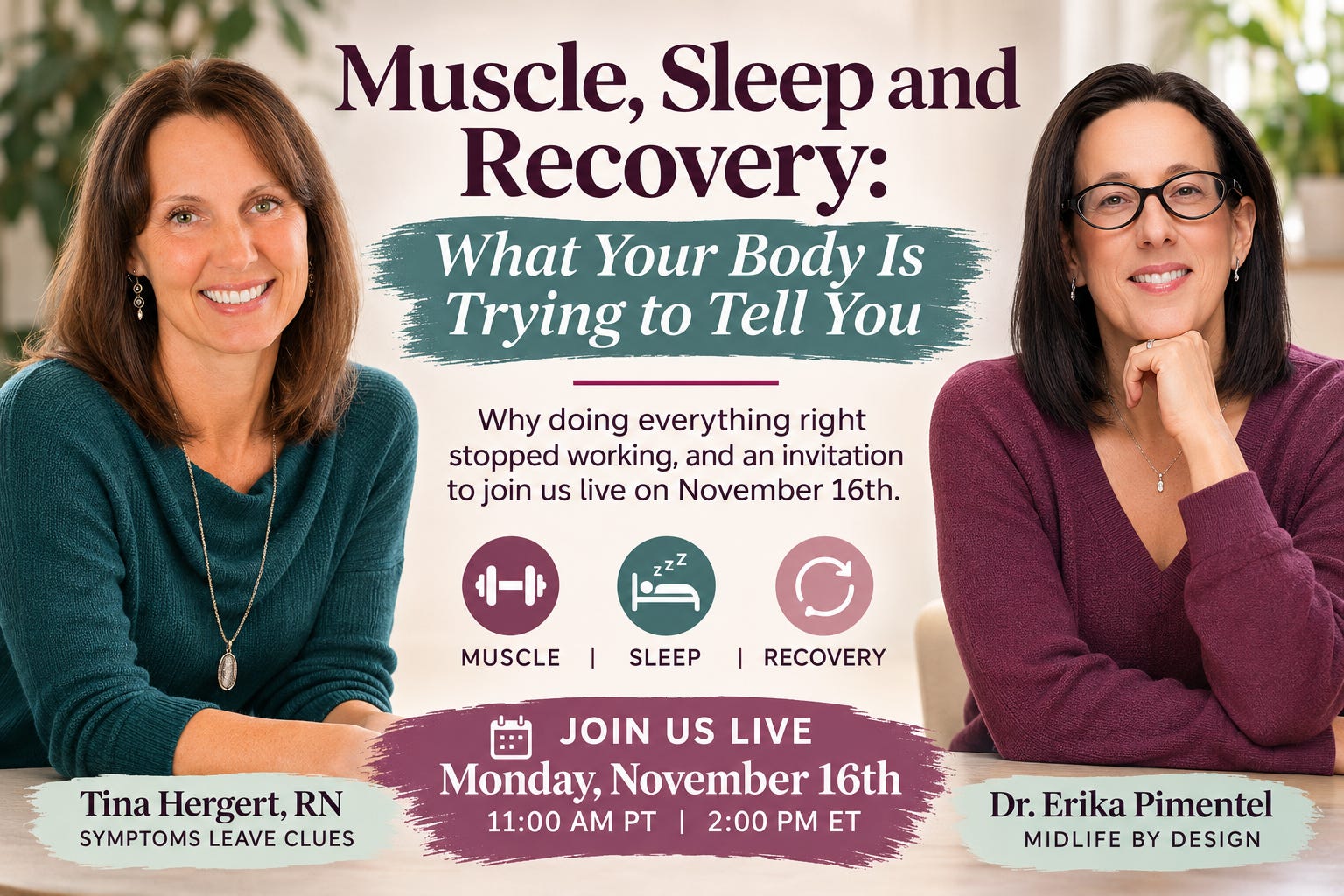
We’re Tina Hergert, RN, a women’s health strategist and the writer behind Symptoms Leave Clues, and Dr. Erika, a Menopause Mentor and the writer behind Midlife by Design. Tina looks at what’s happening on the inside, from your hormones and blood sugar to what your labs are really saying, while Erika looks at how all of that shows up in your training, your sleep and your recovery.
Your health is shaped by a lot of moving parts, including nutrition, stress, your environment and everything you’re juggling day to day. For this conversation, we’re zooming in on three that are deeply connected and that trip up so many of the women we work with: muscle, sleep and recovery. They aren’t three separate projects. They work as one system, and your body is giving you information about all three every single day.
One week from today, we’re going live together to connect the dots. Here’s a taste of what we’ll cover.
It starts with your hormones (but it doesn’t end there)
Tina: When most people hear “hormones,” they think of estrogen and maybe progesterone. But insulin is a hormone, cortisol is a hormone, and your thyroid runs on hormones too. None of them work alone. I always say hormones are friends: where one goes, the others follow.
That’s why muscle, sleep and recovery are so tangled up together: the same handful of hormones runs all three. Estrogen helps insulin do its job, so as estrogen declines, blood sugar gets harder to manage, and those swings can wake you up at night. Estrogen also helps protect your muscle, so as it drops, muscle gets harder to build and keep. Progesterone is the calm and happy hormone that helps you sleep, and is often one of the first to slip in perimenopause. Testosterone helps you keep your muscle and strength, and yes, women need it too. Cortisol keeps you going under pressure, but when it never gets to clock out, it works against insulin, sleep and your recovery.
On the live, I’ll kick us off with a quick tour of how your hormones play off each other. It won’t be a lecture, just enough of a foundation that when Erika talks about why your workouts feel harder or why your sleep fell apart, you’ll know exactly which piece is pulling the strings.
If you want a head start, read Not Everything Is Your Hormones (But Some of It Totally Is).
Muscle is a vital sign
Tina: I call muscle the vital sign of longevity, and I’m not being dramatic. In a global study of nearly 140,000 adults across 17 countries, grip strength predicted the risk of dying from any cause better than systolic blood pressure did, with every drop of about 11 pounds in grip strength linked to a 16% higher risk of death.
Muscle is also where most of the sugar from your meals is meant to go. The more muscle you have, the more places that sugar has to land, rather than lingering in your bloodstream or getting tucked away as belly fat. That’s one reason muscle is a top contributor to your overall metabolic health, and it’s about far more than how your jeans fit. It’s also why losing muscle in perimenopause hits so hard. In the SWAN study, which followed women through the menopause transition, fat mass more than doubled while lean muscle declined.
I’ve worn a continuous glucose monitor to watch this play out in my own body, and some of what it showed me caught me off guard. On the live, I’ll share what I saw and what I changed because of it.
Erika: Muscle matters for far more than how it looks. Strength training supports your metabolism, your bones and your ability to carry the groceries, climb the stairs and move through your day without thinking twice. Muscle also releases signaling molecules that communicate with other tissues in your body, so building it is doing work you’ll never see in the mirror.
If you’ve been training and the scale hasn’t moved, that doesn’t mean nothing is happening. The scale measures your total weight, but it can’t tell you how much of that is muscle and how much is fat, and some of the most meaningful changes a woman makes never show up there at all.
On the live, I’ll talk about where to start if you’ve never picked up a weight, and why starting right where you are is enough.
Sleep runs the show
Erika: In my article, What Does Your Body Need to Do While You Sleep and How Does Midlife Interrupt It?, I walked through the work your body does overnight, from deep sleep repairing your tissues to REM processing your memories and emotions. Some of my biggest lessons, though, came when I started tracking my sleep with a wearable alongside my daily habits, which helped me notice a connection I hadn’t expected between everyday worries and the nights I struggled to sleep. I’ll share the whole experiment on the live.
Tina: Sleep touches virtually everything else in your body, from your hormones and energy to your cravings and recovery, and it works faster than most of us realize. In one study, healthy adults who slept four hours instead of eight were measurably less responsive to insulin the very next day. That’s the effect of a single short night’s sleep.
Short sleep also scrambles your hunger signals. In another study, just two short nights reduced the hormone that tells you you’re full, raised the one that tells you you’re hungry, and sent cravings straight toward sweets, chips and bread. So that 3 p.m. sugar craving isn’t a willpower problem. It’s a sleep problem wearing a blood sugar costume.
On the live, we’ll talk about what to listen for when your sleep changes, which changes deserve a conversation with your provider and where to start if you want to improve it without overhauling your whole life.
The workout is only half of it
Erika: Strength training gives your body a reason to adapt, and recovery is where that adaptation actually happens. Enough food, rest between sessions and good sleep all support the process. When they’re missing, you can train hard and still feel like you’re going backward, with slower progress, soreness that lingers, workouts that feel harder than they should and a tiredness that doesn’t lift. Those are signals worth paying attention to, not proof that you need to push harder.
Tina: Here’s the part nobody tells you: your body doesn’t sort stress into categories. A hard workout, a work deadline, a sick parent, a skipped lunch and a bad night of sleep all land in the same bucket. When that bucket stays full, cortisol stays elevated, and chronically high cortisol breaks tissue down instead of helping it rebuild. That’s how one more intense workout on top of a full bucket can tip you backward instead of forward.
On the live, we’ll each share the one change we’d make this week to support your recovery. Spoiler: neither of us is going to tell you to do more.
Join us live, one week from today
One week from today, on Monday, November 16th, at 11:00 a.m. Pacific, 2:00 p.m. Eastern, we’re going live together on Erika’s Substack, Midlife by Design, for “Your Sleep Is Giving You Clues. Here’s How to Read Them.”
We’ll start by laying the hormone foundation, then dig into how muscle, sleep and recovery feed each other and what your body might be trying to tell you along the way. You’ll hear what Tina’s glucose monitor revealed and what Erika learned from tracking her sleep, and you’ll walk away with one thing you can put into practice that same week. Bring your questions, because we’re saving time for them.
Before then, we’d love to hear from you. Which feels hardest right now: muscle, sleep or recovery? Leave a comment or hit reply and tell us, and your answers will help shape the conversation.
Your body is giving you information every day. Let’s learn to read it together.
Tina and Erika
This article is education to help you understand your body and advocate for yourself. It isn’t medical advice and doesn’t replace a conversation with your provider.
Sources
NEJM Journal Watch CardioExchange, on Leong et al., The Lancet 2015 (PURE study)
UCLA Health, on Greendale et al., JCI Insight 2019
ScienceDaily, on Donga et al., Journal of Clinical Endocrinology and Metabolism 2010
UChicago Medicine, on Spiegel et al., Annals of Internal Medicine 2004